
What Is a Handmade Shoe?
I’ve written about this before, and yet it still seems to be one of the most misunderstood topics in the shoe world. If anything, it’s gotten worse. The term “handmade” gets thrown around so casually now that it’s almost lost all meaning, and that’s exactly why it needs to be addressed again.
Because this really shouldn’t be complicated. A handmade shoe is a shoe made by hand. That’s it. No more, no less.
And yet, somehow, that very simple idea has been twisted into something that now includes factory-made shoes, machine-stitched constructions, and anything else that sounds good on a product page. Now, everyone’s shoes are handmade, at least this is what they tell you.
Where it All Went Wrong
Back when shoes were first made, everything was handmade. There were no machines, no factories, no shortcuts. A shoemaker had his tools, his materials, and his skill. That was the process.
Then machines came along, factories became the norm, and production scaled up. That’s all fine. That’s progress.
But somewhere along the way, instead of keeping the distinction clear, the term “handmade” started getting stretched. Now it’s used to describe anything where a human being is involved in the process, which, if we’re being honest, is just about everything.
That’s where the problem begins.
You see it all the time. Brands showing videos of someone clicking leather by hand, when in reality, most of it is done by machine. Salespeople telling customers that shoes sitting on shelves are handmade, simply because that sounds better. And customers believing it, because no one has taken the time to explain otherwise. The soft lie becomes okay because who is going to call you on it? Apparently, just me!
👉Watch the YouTube podcast here:
Factory-made Does Not Mean Handmade
One of the biggest confusions I see is people thinking that if a person is involved, the shoe must be handmade. It’s not.
A factory is a production environment. Machines do the work. People operate those machines. That’s the entire point of a factory.
And let me be clear — that doesn’t take anything away from the people working there. Quite the opposite. The people who operate these machines are skilled. Lasting a shoe properly on a modern machine is not easy. Stitching a sole cleanly and tightly takes experience. Trimming a welt so that it looks clean and refined takes a good eye and a steady hand.
But they are not making the shoe by hand. They are not sewing stitch by stitch with the movements of their two hands. Guiding a shoe in the machine is not doing the work ‘by hand.’ They are working machines that ultimately make the shoe.
That’s an important distinction, and it’s one that too many people either don’t understand or choose to ignore. The latter is clearly the case since everyone these days prefers to live in a fantasy rather than deal with reality. It’s why Instagram and TikTok are so popular.

What a Real Handmade Shoe Actually Is
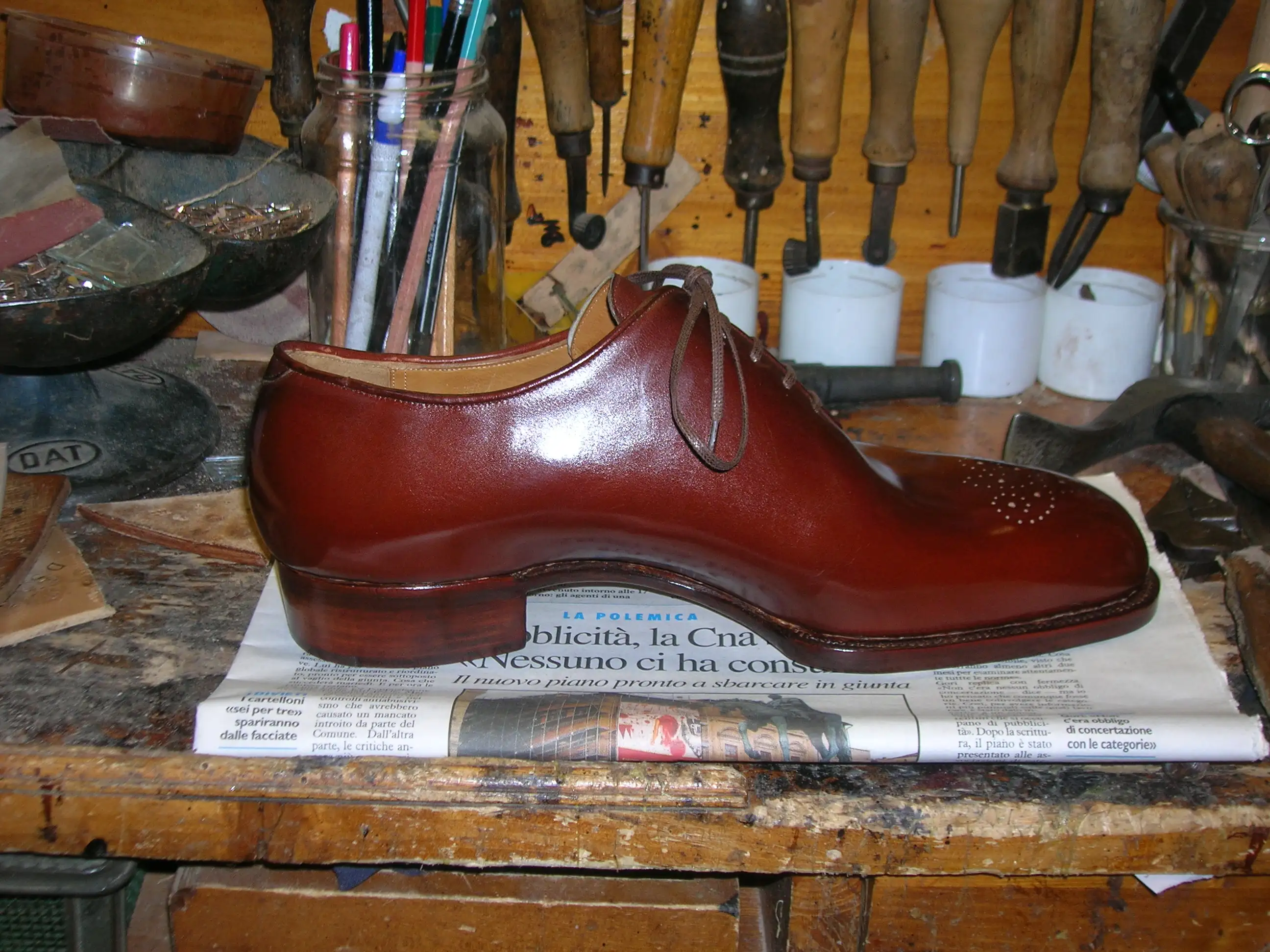
Now, having actually made shoes by hand, I can tell you that the difference is not small. It’s a completely different process.
You’re working with a knife, an awl, a hammer, thread, leather, and a handful of basic tools. You’re cutting your insoles by hand. You’re building your heels piece by piece. You’re shaping and finishing everything yourself.
And when you’re learning, it’s not pretty. You cut your hands, you stab your fingers, you make mistakes constantly. It’s slow, frustrating work that demands patience. But when you finally finish a pair, you understand exactly what “handmade” means.
That’s why it bothers me when the term gets used so loosely. Because that level of work, that level of skill, gets reduced to a marketing word. It’s insulting to all of the people who have actually dedicated their lives to learning a craft that takes years to perfect.
The only real exception in the process is the upper stitching. That’s almost always done by machine, and for good reason. Doing it by hand offers no real benefit and would just make the process unnecessarily long and expensive.
But beyond that, a true handmade shoe is exactly what the name implies. It’s made by hand.
Where Things Start to Blur
Now, to be fair, there are levels to all of this. There are makers who do almost everything by hand but will use a sanding machine to finish the sole or the heel. There are others who will use pre-cut heel blocks instead of building them piece by piece. These choices speed things up and bring the price down.
If you want to be extremely strict, you could say that any use of a machine disqualifies the term. That’s where you get into the real purist territory. Personally, I don’t go that far. I understand the practical side of things. But the more you rely on machines, the further you move away from what most people would consider true handmade shoemaking.
Then you have smaller workshop operations, where a lot of the work is done by hand, but certain steps — like sole stitching or finishing — are done by machine. These shoes are often excellent. They can look fantastic and offer great value.
But again, if we’re being accurate, they sit somewhere in between. They’re not fully handmade in the purest sense.
The Biggest Misconception: Handwelted Equals Handmade
This is where most people get it wrong. Handwelted does not mean handmade.
Yes, parts of the process are done by hand. But the shoe is still made in a factory environment, with machines involved throughout. It’s still a production shoe.
The same goes for Goodyear welted and Blake stitched shoes. These are machine-based constructions. That’s literally what they are. So when brands or salespeople call these handmade, they’re either misunderstanding the process or deliberately blurring the lines.
Why This Actually Matters
At this point, some people might think this is all semantics. But it’s not.
Because when everything is called handmade, the term stops meaning anything. And when that happens, people lose the ability to understand value. If a $300 shoe and a $3,000 shoe are both labeled handmade, how is anyone supposed to know the difference? Why would one cost ten times more than the other?
This is why people question bespoke pricing. They’ve been told that everything is handmade, so the distinction disappears.
But the reality is, those products are not the same. Not even close. People should want to know that. Living in a fantasy doesn’t help anyone.
A Quick Reality Check
And here’s the irony in all of this. Some of the most beautiful shoes in the world are made in factories.
And some handmade shoes are not that great.
So even beyond all of this, the word itself doesn’t guarantee anything. It doesn’t guarantee beauty, it doesn’t guarantee quality, and it certainly doesn’t guarantee that you’re getting something better.
Well-made is well-made. That’s what matters.
Final Thought
So let’s just keep it simple.
A handmade shoe is a shoe made by hand. Not a shoe touched by hand, not a shoe assembled in a factory, not a shoe described that way because it sounds nice.
And there is nothing wrong with factory-made shoes. In many cases, they are excellent. They are made by skilled people who know exactly what they are doing.
But let’s stop pretending they are something they’re not.
Because when everything becomes “handmade,” the word loses its meaning entirely, and that doesn’t help anyone — not the customer, not the industry, and certainly not the people who actually make shoes by hand.
If you enjoy my educational posts, make sure to read the rest here, or check out my YouTube channel, where you can hear my thoughts in voice form.
—Justin FitzPatrick, The Shoe Snob
Shop · Marketplace · Patreon




at last someone open up about handmade shoes, thanks Justin!
That Would you say about silvano Lattanzi?
Some G&G may be hand made – the bespoke ones.
yes I realize I forgot to make the distinction, assuming that people would know that I was talking about their RTW stuff
For this discussion, can you discern between handmade and machine made ?
A lot of fancy tailors cannot discern between bespoke and a high quality machine made clothing.
If no, is this a discussion we should be having in the first place. If in the end it doesn’t matter -it shouldn’t matter. If I cannot tell the bread I’m having is hand made or not, it probably doesn’t matter. Just my 2 cents.
If yes, tell us how to discern. You did lay out a lot of points. But for the average joe, can they discern handmade and an extremely good quality machine made shoe?
Hi, i am a bootmaker myself. And i guess in 95% of the footwear out there i could tell you immediately if it was handmade or not. When taking it apart for repair probably 99%. There are lots of distinct details typical to handmade shoes that a machine simply never could do(or the development of such machines would be rediculously needless and over the top. spaceX-like). And for the same reasons i really cannot believe, that any tailor wouldn’t be able to discern between the two.
Also it is not that simple as there is not only handmade or machine made, but hundrets of ways the two are being combined in between. This post focuses on where the line should be cut between the terms. To respect the trade, if you will. And that said you can have a machine made shoe with a lot of handwork in it, that of course will be harder to discern from a fully handmade shoe than a nike for instance. So yes! There are major differences between hand- and machine made shoes and yes, you can make a relatively industrialized shoe that comes kind of close to handmade quality and looks. But: the more hand labor, the better the product really is no fairy tale in footwear!! And that counts for many basic and practical things in my opinion. Few things in this category(basic+practical) actually improved since some snobs took mass production to different levels in the first half of the 20th century. They want you to think that they did, that’s for sure, but i say we had a few millennia of time to perfect basic, practical things. And when you see(or execute) the old techniques of the shoemaking trade and the way they engage with each other, developed over centuries, that is just stunning. So to me it does matter. Best regards
Thank you for sharing
Dear Justin,
I can say something about all this.
The customer who buys a “handmade” shoe that demands to see the production process, any real craftsman who does this “well done”, will show his work proudly.
The quality of the handmade shoe, is not only in sewing by hand.
All the hidden parts inside the shoe, Tope, buttress and jimmies were made with vegetable tanned leather, given the way by wetting and hitting … when the shoe at its foot picks up moisture, these shapes adapt in a certain way to its physiognomy , and it’s healthy to perspire.
Another important point is the heel made to strata, this guarantees a correct seat of the shoe.
The gap created when sewing the fence and the insole is very subtle, almost non-existent, so the insole does not sink as it happens in goodyear.
Then the sewing by hand, the handwelt and also the stippling of the sole, this is like welding two pieces, each stitch is crossed and this does not happen in the machine.
We also have the flexibility.
It should be borne in mind that there may also be badly made “handmade” shoes … poor workmanship or poor quality materials.
Best regards
Enrile
Bespoke is a much abused term in tailoring and menswear in general. I am a
dentist. At a guess I have placed about 50,000 fillings. Every one of
these has, by necessity, been “bespoke” and “hand made” but,
of course, I have never used those terms. I have also fitted
thousands of crowns, most of which have been hand made (by a
technician, not by me). But over the last decade the whole industry
is slowly moving away from hand made towards machine made mainly, at
the moment, for crowns, bridges, and dentures. I am sure fillings
will follow later. Ten years ago all the crowns I fitted were hand
made. Today 95% of them are machine made either by CAD-CAM milling,
3D printing, or laser sintering. There are several advantages but,
from my point of view, the most important are improved strength and
better fit. My patients would probably mention the improved
aesthetics. There is also a cost saving, mainly because it is not
necessary to use precious metals. Everything is still “bespoke”
and there is always an element of hand work mainly in the area of
aesthetics, especially for work being done at the front of the mouth.
So I am moving from bespoke/hand made to bespoke/machine made to improve
quality.
So…accepting the many benefits is aesthetics, comfort etc. from having bespoke
shoes made are there any advantages to machine made? I am thinking,
for instance, strength of stitching or improved bonding of the
various elements that might need adhesive but I guess there might be
others.
Dear Michael,
Really the machine and the new materials, helped make a shoe less expensive, but not better than a “well done by hand” shoe.
Although we want to compare constantly, they are simply different things ….. like pears and apples.
Dear Justin,
On which category would you put Bestetti Bespoke or Novecento line ?
Thanks a lot!
can’t say for sure as I have never see the work done in person. I have seen sanding machines in the workshop but not sure if they were also used for bespoke or only for Novecento
Ok, thanks a lot for answering !
great site Justin! – wanted to pick the brains of the informed folk on here – I love stylish shoes with Norvegese, (Norwegian) construction soles/stitching, (the real ones not the aesthetic mimics). Can anyone recommend some quality brands that feature these and bonus if they do not require a mortgage to purchase lol.
yes benchmade is usually done with human’s working at machines, whereas mass produced is usually conveyor belt style with limited human necessity and machines doing nearly all of the work
Hi Justin,
Thanks for this informative piece! I know Santoni can be particularly bad at claiming shoes are entirely handmade despite that simply not being the case. However, do you know if this is the case for their limited edition line? I’ve seen lots of conflicting information but supposedly there truly are entirely handmade do you know if this is the case or not?
Thanks!
Tom
To the best of my knowledge they do not hand welt or hand sew any soles. Everything is made in their factory with the assistance of a machine. Pretty sure they are just goodyear welted
Thanks very much for this Justin, it’s greatly appreciated! Keep up the great work 🙂
Tom
Thanks Tom, I appreciate the kind words!
Clearly thought out, clearly written educational article. Well done.
Thank you Thomas, I appreciate it!
The more I learn, the more I appreciate your posts Justin. Thank you.
Thank you for saying so Brett, I appreciate that
“People should want to know that. Living in a fantasy doesn’t help anyone.”
It helps many people who cannot afford bespoke, but want to be previlidged, fakely.
I don’t bother with this kind of people, they don’t belong to this fine products.
Exactly 😉
Sometimes I like to imagine two old shoemakers in the 19th century, debating whether machine-stitched uppers can be considered part of a “handmade” shoe. Meanwhile, I, and others, will continue to do what we consider “truly handmade” today.
Regards
Enrile
Thanks for sharing my friend 😉