The Myth of the Universal Shoe Size Guide
There is no such thing as a universal shoe size guide.
Let me repeat that because it is one of the biggest misconceptions in the shoe industry: there is no single chart, conversion rule, or magic number that tells you what size you are in every brand, every last, every country, and every style of shoe.
And yet, people cling to shoe sizes as if they are part of their identity.
“I am always a UK10.” — “I wear a US9.” — “I am a 43.”
No, you are not. Or at least, not in the way you think you are. You might be a UK10 in one brand, a UK9.5 in another, a US10 in one last, and a US9.5 in another. You might be a 43 in sneakers and a 42 in dress shoes. You might even be two different sizes within the same brand, depending on the shape of the last.
That is not the brand being wrong. That is also not necessarily the shoe size guide being useless. That is simply how shoes work.
A size guide is a guide. It is not a law. And sizes are also an interpretation, not a fact. The idea of a US10 is not the same, no matter who says so.
Why Shoe Size Guides Can Be Misleading
The problem with a shoe size guide is that most people treat it as a guarantee. They see a conversion chart that says UK8 equals US9, or EU42 equals UK8, and they assume that is the end of the discussion. But it is not. Far from it. The idea of a size is usually just based on length. It does not account for width, nor depth/instep, etc.
Shoe sizing is not universal because shoe lasts are not universal. For those unfamiliar with the term, the ‘last’ is the form around which the shoe is made. It determines the shape, volume, width, instep, toe box, heel, and general fit of the shoe. Two shoes can technically be marked the same size and still fit completely differently because they were made on different lasts.
That is where most people get into trouble. They think size is only about length. It is not. Length is just one part of fit. Width matters. Instep matters. Heel shape matters. Toe shape matters. Volume matters. Arch placement matters. And when you are dealing with welted dress shoes, where the structure is firmer and less forgiving than a sneaker, all of these details become even more important.
This is why a shoe size guide might get you into the general neighborhood, but it will not always get you through the front door.
UK to US Shoe Size Conversion Is Not Always the Same
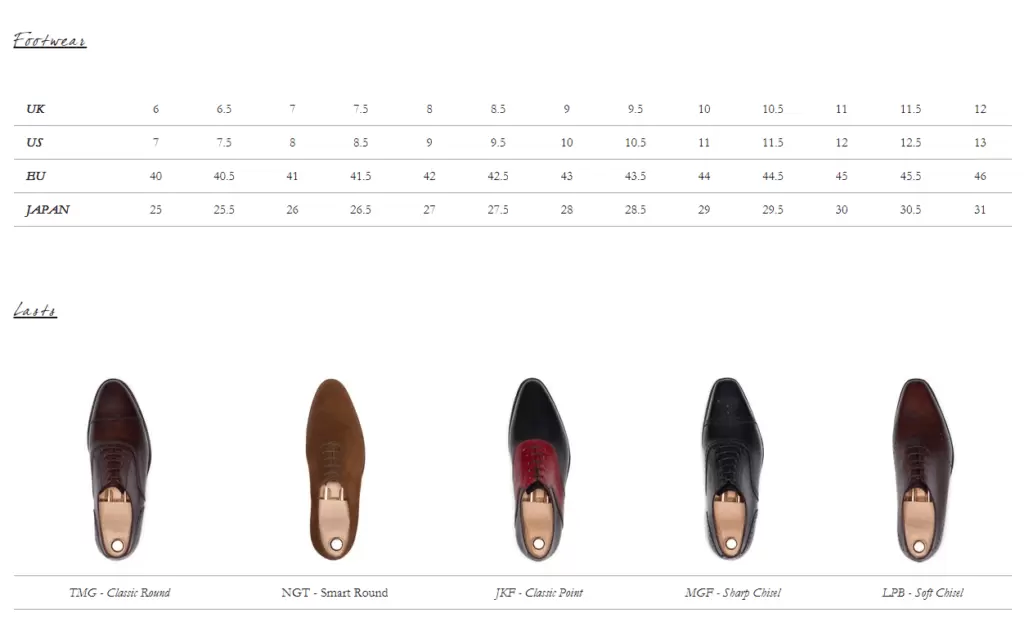
One of the most common areas of confusion is the difference between UK and US sizing. Some brands work on the idea that a UK8 equals a US9. Other brands work on the idea that a UK8.5 equals a US9. So which one is correct?
Both. And neither. That is the frustrating part!
A Gaziano & Girling UK8 is not the same as a Crockett & Jones UK8. Not even close.
It depends entirely on the brand’s interpretation of its own sizing system. This is where people get caught out because they assume the conversion is mathematical, when in reality it is often brand-specific.
For example, if you are a US9 and want to buy Gaziano & Girling, you might very well need a UK8.5. If you are a US9 and want to buy Crockett & Jones, chances are you might need a UK8. Then you get to a brand like Carmina, and even that answer can change depending on the last. In the Simpson last, you might need a UK8.5. In the Rain last, you might need a UK8.
So what does that tell us? It tells us that a shoe size guide is only the beginning. The real answer comes from understanding the brand, the last, and how that particular model fits.
The Last Matters More Than the Number
This is the part many customers underestimate. They want the answer to be simple. “What size am I?” But the better question is, “What size am I in this brand, on this last, in this model?” But that takes work, that takes research. That is the reality for the world we live in, where people want to try many brands and models. If you just wear the same shoe in the same brand, you are good in your standard US10. But if you want to diversify and try different brands and models, then you have to relinquish your idea of what size you might be.
A sleek, narrow, chiseled last is not going to fit the same as a round, generous country last. A loafer is not going to fit the same as an oxford. A boot might allow for a slightly different fit than a dress shoe. A wholecut might feel different across the instep than a derby. Even materials can slightly affect fit, as some leathers have more give than others.
This is why saying “I am a UK9” does not mean much without context. A UK9 in what? A UK9 in Edward Green? In Carmina? In Crockett & Jones? In Meermin? In sneakers? In loafers? In boots? In a soft suede loafer or a stiff calfskin oxford?
The number alone does not tell the whole story.
Widths Are Also Not Universal
Width is another part of shoe sizing that people assume is standardized, when it absolutely is not.
An E width in one brand can feel like a D in another. An F width in England can be standard for one maker and wide for another. In American sizing, D is often considered standard for men, while E, EE, and EEE move wider (for US Standardization). In UK sizing, the letters do not always translate the same way. Often, a UK ‘E’ width denotes a standard fit, such as is the case with Gaziano & Girling and Crockett & Jones. Whereas, with Cheaney, it is an F width that is the ‘standard.’
And then there is the problem of volume. A foot can be narrow but high-volume. It can be wide in the forefoot but narrow in the heel. It can have a high instep but average width. It can measure a certain width on paper, but feel completely different inside a shoe depending on the shape of the last.
I learned this the hard way when I went to Spain to make my lasts. I asked them to make me a UK8 in E width. What came back fit more like a G width to me. Why? Because their interpretation of E width was not the same as mine.
That is the entire point. Sizing is interpretation. A shoe size guide may give you a number, but the last gives you the fit.

Foot Shapes Around the World: Another Sizing Variable
You also have to consider that feet are not shaped the same across the world, and many brands develop their lasts around the foot shapes most common in their own market.
Of course, these are broad generalizations, not hard rules for every individual. But in shoemaking, regional fitting tendencies absolutely matter.
Here’s a broad-stroke view:
- Americans: Narrow, shallow feet and/or very wide, girthy feet.
- Europeans: Higher insteps
- Africans: Long, flat feet with girth
- Asians: Shorter feet, wide forefoot, narrow heel, flat arches
- Latinos: Broad feet, very high insteps, shorter overall length
That does not mean every person from a certain background has the same foot. Far from it. But it does show why a single shoe size guide can never account for everyone. A chart cannot know whether your foot is narrow, flat, high-volume, broad across the joints, shallow through the instep, or narrow in the heel.
So again, treat size charts as guidelines, not gospel. They can point you in the right direction, but they cannot replace understanding the brand, the last, and your own feet. No single size guide can account for all of these variations.
Why Online Shoe Buying Requires More Homework
Buying shoes online is convenient, but it also puts more responsibility on you, the customer. This is where the issue lies, where many customers think that online shopping should be convenient. And to a degree, that is true, when buying standardized products like plates, cleaning products, toilet paper, etc. But not when buying three-dimensional products made for feet, that can be different from left to right!
In a shop, you can try the shoes on, walk around, feel the heel cup, test the instep, and see whether the vamp bites or the quarters close properly. Online, you cannot do any of that. So you have to replace that physical experience with information. And a lot of it, from multiple sources. That is, if you want to try to get the best chance at getting it right on the first go.
That means asking questions before buying. Not after and then complaining because you failed to read, because you couldn’t be asked.
If you are spending hundreds of dollars on quality shoes, do not simply look at a shoe size guide and hope for the best. Email the brand. Ask how the last fits. Tell them what you wear in other brands. Mention your foot shape. Tell them if you have a high instep, wide forefoot, narrow heel, or any recurring fit issue.
The more information you give, the better advice you will receive. And if you do none of that, order blindly, and then act shocked when the shoes do not fit, you only have yourself to blame.
How to Shop Smart for Proper Fit
If you are spending hundreds, or even thousands, on quality shoes, do not simply pick a size from a chart and hope for the best. A shoe size guide can give you a starting point, but it should never be the only thing you rely on.
The first thing to do is contact the brand directly. Tell them what size you wear in other brands, and be specific. Saying “I am usually a UK9” is not very helpful. Saying “I wear UK9 in Crockett & Jones 348, UK9.5 in Carmina Simpson, and US10D in Allen Edmonds Park Avenue” gives the brand far more to work with.
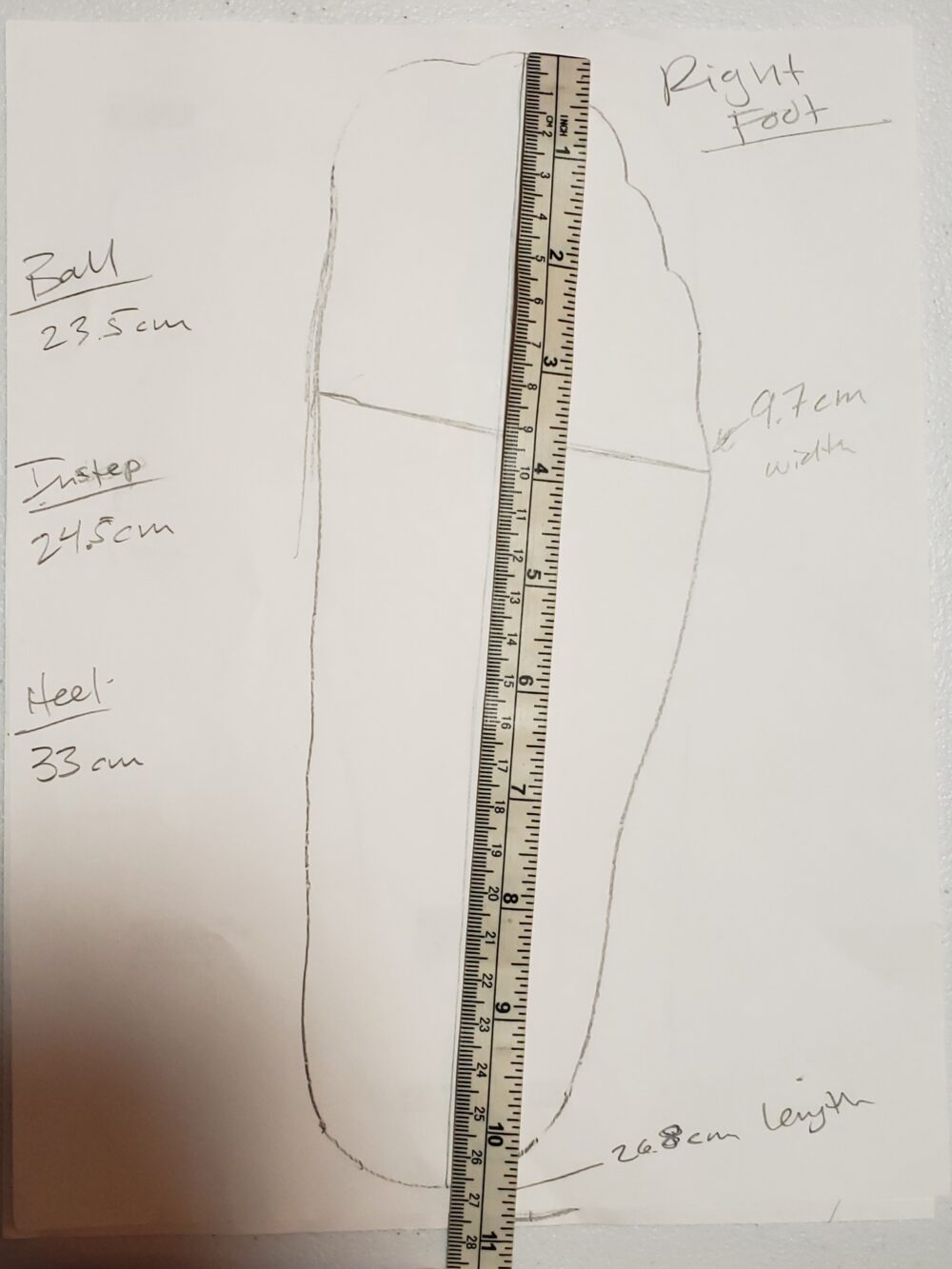
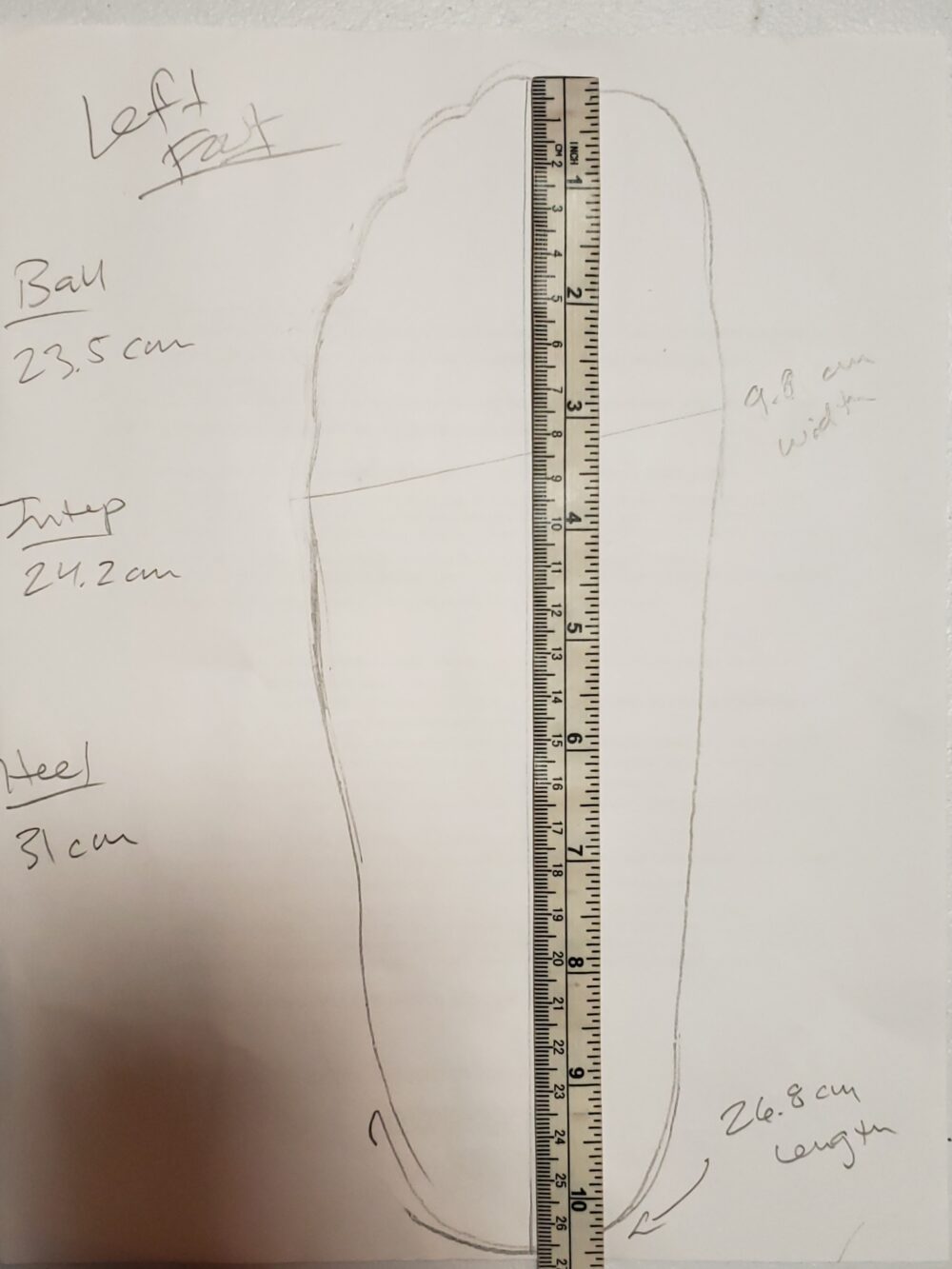
You should also know your own foot measurements, but do not obsess over them as if they are absolute. Length, width, and instep height all matter, but measurements are still only part of the puzzle. Your foot changes shape when standing, walking, and bearing weight. It spreads, flexes, and moves in a way that a static measurement cannot fully capture.
The same goes for insole measurements. They can be useful, but they are not an exact science either. A properly fitting shoe will often have an insole that measures smaller than your fully splayed-out foot. That does not automatically mean the shoe is too small. In fact, trying to match your foot measurement exactly to the insole measurement can easily lead to a loose-fitting shoe, especially in dress shoes where heel hold and overall volume are so important.
Understanding the last is just as important as knowing the size. Ask how the last fits compared to the brand’s other lasts. Does it run long? Is it narrow through the waist? Is the instep high or low? Is the heel generous or snug? These details matter far more than whether a chart says UK8 equals US9.
It is also worth researching what other customers wear in that brand, especially if they compare it to brands you already know. If someone says they wear UK8 in Crockett & Jones but UK8.5 in Gaziano & Girling, and you know your Crockett & Jones size, that gives you a useful reference point. It is not perfect, because their foot is still not your foot, but it can help you make a more educated decision.
Before buying from a brand you do not know, especially online, ask questions like: how does this last fit compared to your other lasts? What size would you recommend if I wear a certain size in another brand? Is the instep high or low? Is the heel narrow or generous? Would this last suit someone with a wide forefoot and narrow heel? Does this loafer fit differently from your lace-up shoes?
Those are the questions that matter. They give you context. A shoe size guide gives you a starting point, but context is what gets you closer to the right fit.
The Problem With Salespeople and Generic Advice
This is another pet peeve. Too often, customers rely on generic advice from someone who may not actually understand the product, the last, or the customer’s foot. Or even care for that matter. Sometimes that advice comes from a salesperson who is just trying to make a sale, not actually help you. Sometimes it comes from another customer online who means well but only knows how the shoe fits his own feet.
That advice is not enough. A person saying “go half a size down” is not universal advice. Half a size down from what? In which brand? From your sneaker size? Your Brannock size? Your UK dress shoe size? Your loafer size? This is how bad advice spreads.
Someone buys a shoe, it fits their foot, and suddenly they are giving universal sizing advice to the entire internet. But their foot is not your foot. Their instep is not your instep. Their idea of “snug” might be your idea of torture. Their idea good fit is not universal. Could be their are wearing the wrong size!
So again, ask the brand. Or ask someone who understands the specific shoes, not just shoes in general.
A Shoe Size Guide Is Still Useful — Just Not Absolute
Now, let me be clear: I am not saying shoe size guides are worthless. Far from it. It is like the Brannock Device, it should be used as a guide, not as a guaranteed fact that you live by.
The shoe size guide has a purpose. A good one gives you a starting point. It helps you understand the brand’s general conversion logic. It gives you an idea of where to begin. It might help prevent someone from ordering a UK9 when they clearly need something closer to a UK8.
But it should never be treated as the final answer. Think of a shoe size guide as a map. It can point you in the right direction, but it does not tell you every bump in the road. The last, model, material, construction, and your foot shape all determine whether that direction is actually correct.
Final Thoughts On Shoe Sizing
The shoe industry would be much easier if sizing were universal. But it is not, and pretending otherwise only leads to disappointment. And complaining about it doesn’t help anyone.
There is no such thing as always being one size. There is no such thing as a perfect conversion chart. There is no such thing as a shoe size guide that accounts for every brand, every last, every width, every foot shape, and every fitting preference.
So stop worshipping the number. Use the shoe size guide as a starting point. Then ask questions. Learn your feet. Learn your brands. Learn the lasts. Make informed decisions before buying, especially online.
Because when it comes to proper shoe fit, the number stamped inside the shoe is only part of the story. The real truth is in how the shoe actually fits your foot.
For more educational posts that help you learn about the shoe industry and the realities of it, make sure to read these posts.
—Justin FitzPatrick, The Shoe Snob
Shop · Marketplace · Patreon



Thanks for sharing your thoughts, Justin; the story of my (shoe) life !!
Insole measurements are definitely useful. I’ve seen so many brands with size charts that get the UK, EU, and US conversions completely wrong. With ecommerce growing, shoe manufacturers really need to get more precise about sizing. And let’s not forget: once you’ve paid customs and taxes, returning a pair isn’t always an option.
My pleasure and thank you for sharing my friend!
Hello Justin again! My name is Jason and i wrote a comment on Youtube before. So my question is about the fit and the right size on Carmina’s loafers and to be more precise i’m reffering to the Forest last. I have a pair of Wooster Allen Edmonds and although i wear typically size 41EU on mocassins i went on the similar which is 71/2 in Allen Edmonds. The fact that i didn’t know is that they were EEE and i am D size. Now that i want to buy a pair of Carminas i wanted to be precise and i’ve measured my feet and they’re 26cm. The guys on Carmina told me that typically i am 7,5 UK size but if i want a snug fit i have to go 7UK (we don’t have a Carmina shop in Greece). As for Magnolias i meant the black ones. You see in Lloyd derby shoes i wear 42EU size but on my Boss mocassins i have to go a step down on 41EU. Also i have a pair of clarks chukka boots and i wear 42EU and on my athletic Peak shoes i also wear the same size . Now if i want to order the Forest loafers, what do you suggest me to do?
Hello Jason, based on all that you write, I think that the safe bet is the UK7.5 as Carmina suggests. I think that the UK7 (US8/EU41) might feel tight.
This is such an informative article! Thanks for sharing. The fact is while we all prefer to buy shoes and other footwear online, the sizing is a pain. Getting it right is the key to fewer returns and hassle free experience. Thanks for explaining in detail. As an Indian footwear brand, we also covered on how to measure shoe size correctly in our blog https://yoholife.in/blogs/all/how-to-measure-shoe-size-for-online-shopping-accurate-step-by-step-guide – you may like to use it as a reference for your Indian audience.
keep up with the good posts!
Cheers!
Thanks,
My thoughts: Even though a US size 9 = UK size 8 – it’s not always a great gauge. My adidas sneakers are size 9, my carmina loafers are size 7, my carmina shoes that are very narrow like the lloret last use 7.5, and I just bought a boot on the soller last and it’s going to be 6.5UK. Either my feet are shrinking or I just don’t know the system.
Luckily I’m in contact with the shoemakers and they usually just advise on how to size. It’s the best way.
I think in your case you are comparing shoes you wear with thin socks versus thicker ahtletic socks. Socks make a huge difference. Also guys will want a tight dress shoe but a looser sneaker. And sneakers are always usually a half to size different. The UK8 = US9 is for dress shoes
Good advice, thank you
At this point I kinda have my shoe sizes, and when using a new last I just inquire to the shoemaker. I do get a bit nervous with new shoemakers because they don’t have a reference point to start me off, but I bought a few pairs from ichigo ichie and he made me a trial shoe.
It would be much easier if we just tried on shoes in stores, but I don’t have any idea of where I would even find shoes of this calibre, in a local store. Carmina has a few stores in major cities, and maybe one day if I’m in london I’ll visit crocket and jones, but it really removes a lot of the guess work.
When I went to Carmina for the first time, I went to the Paris store to get my size but my feet were 1 – wearing sport socks, and 2 – probably bloated from flying the day before. so I got the wrong size when they delivered them. They later sent me some extra insoles to glue in on top, but it was definitely a learning experience
Yea, buying shoes can be tricky for sure. Blessed are those with ‘standard’ feet who fit all well
It can get complicated. I learned from my mistakes. When are you going to release your new line of shoes?
For sure. New line of shoes will come in stages. Sneakers/casual shoes will come this Summer. New, welted shoes likely not until early 2027 – those take a lot more time to recreate
I’m from Uganda, kampala!! 42 is my favourite size forever I
This is the 3rd post on this blog that I have just read (googling about shoe widths),
and they all talk about width, and use letters like D, E, F, etc.
But NONE of them have said what those letters mean? What is the scale?
BTW, I am googling because a pair of UK 8 (only size avail on Amazon) I bought turn out to be way narrow than my normal US 9 (or US 8.5Wide).
Here are a few more that might help: https://theshoesnobblog.com/uk-to-us-shoe-size/
https://theshoesnobblog.com/mens-shoe-widths-an-idea-of-interpretation/