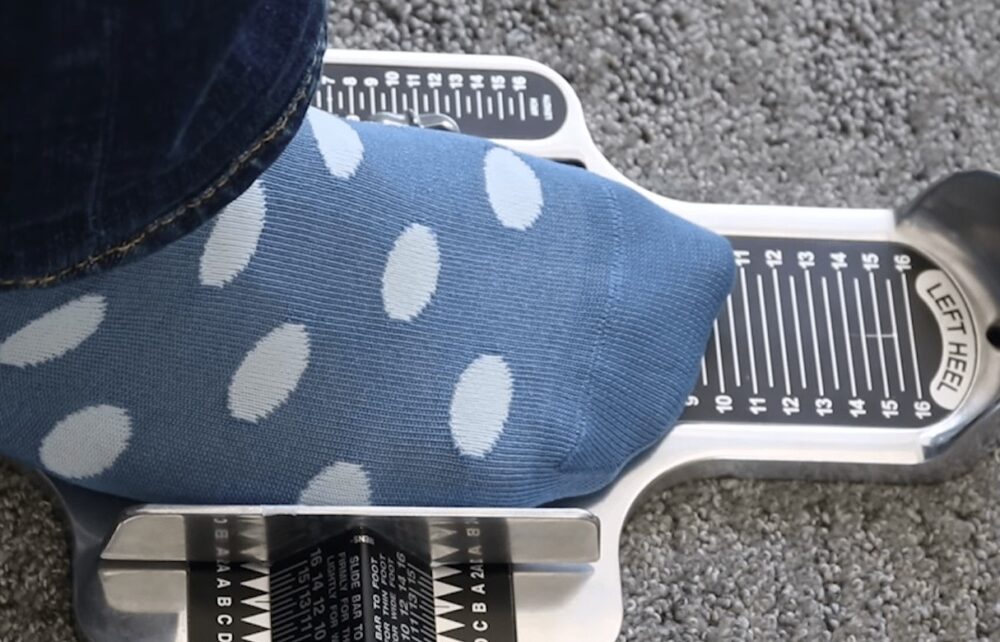
I have fit and measured thousands—literally tens of thousands—of people in my life looking to buy dress shoes. And in doing so, I’ve learned a lot about fit, how it differs from person to person, culture to culture, and why the Brannock Device as a shoe sizing method is not what it’s cracked up to be.
The Brannock Device is often treated like the holy grail of shoe sizing. It’s not. It has its place. But that place should only be a guideline—a starting point—and nothing more.
Feet Are More Complex Than Two Numbers
Feet are not simple. They are one of the most complex parts of the body when it comes to fit. You have length. You have width. But beyond that, you also have inside arch, outside arch, instep height, ankle height, toe thickness, heel girth—and the list goes on.
All of these factors affect how a shoe fits. The problem is simple: your foot is three-dimensional. The Brannock Device is not.
And what does it actually measure? Length and width… and supposedly arch length. I say “supposedly” because I never fully trusted that measurement.
For example, I measure at an arch length of around a US11, yet the length is 8/8.5. My feet are semi-flat, long, narrow, and shallow. So, if I put on a US9 shoe—which is already pushing it—my arch feels like it’s being overworked. Imagine me in a US11. I would be literally swimming in it.
I know this from experience. When I was younger (and dumber), I wore larger shoes based on my Brannock Device length. Big mistake. My feet paid the price as I was wearing shoes too big. This caused plantar fasciitis, and it only went away after I sized down.


Why Width Measurements Can Be Misleading
Even width, which people tend to rely on heavily, can be deceptive.
I’ve measured customers at 3E width and watched them swim in the shoes. I’ve measured others at E who fit perfectly into a standard D., and I’ve seen the opposite—someone measuring E but needing 3E due to the depth/girth/instep of their foot, not the width.
That’s something the Brannock Device doesn’t properly account for: volume.
A foot can be wide side-to-side, or it can be thick top-to-bottom. Those are very different fits—but they often get treated the same. Yet the Brannock device can only measure one of them: side-to-side. So are people who measure US9 in length, D in width, but have fleshy feet in height, supposed to follow the Brannock? No, they wouldn’t even be able to enter a US9D shoe.
The Biggest Mistake: Thinking You’re One Size
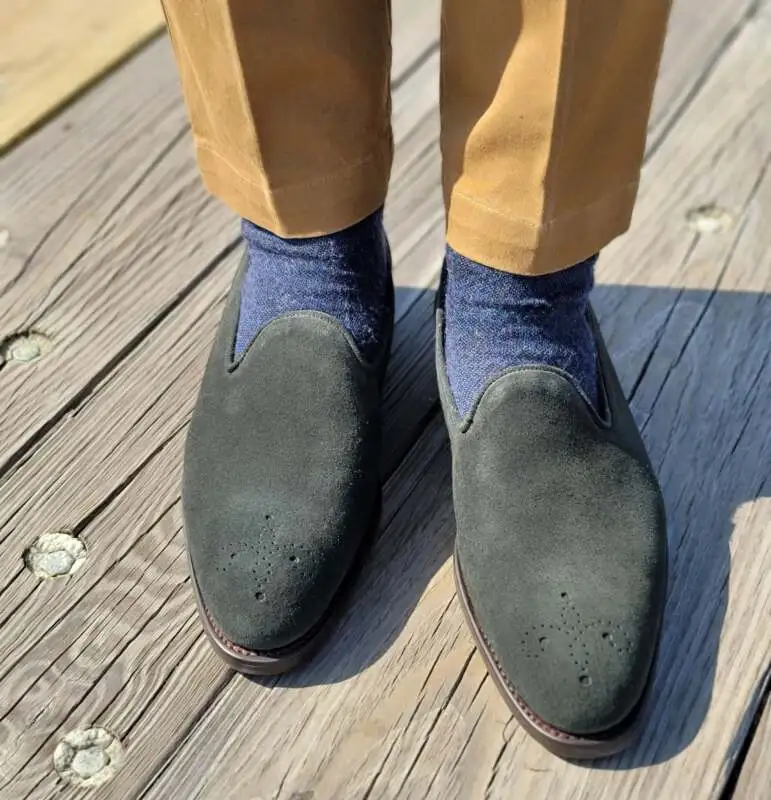
While the Brannock Device is the focus here, it’s not the only issue. The bigger problem is believing you are one fixed size.
You might be a US9D in Nike.
But in Allen Edmonds, you’re a US8.5.
In Santoni, you’re a US8.
And in Paul Parkman, you might be a EU40.5 (US7.5).
So what does your Brannock measurement really tell you? A theory. Not a fact.
It always drove me crazy when American guys were like, ‘I am a US10. In everything.’ Like, okay bro, sure thing. They were a size US10 in everything, but fit poorly in 80% of it.
Fit Is Also Cultural
This is something most people never think about. Fit is not universal—it’s highly cultural.
Many French clients don’t want a single molecule of extra space in their shoes. They will wear shoes that look smaller than their feet. Dominicans are the same. Meanwhile, many Americans want their dress shoes to feel like sneakers—roomy and forgiving. They go the opposite direction and are often wearing shoes ½-1 size too large. You have all seen this. It is so obvious when a guy is wearing a shoe too large.
Many Asian people will get shoes too large so they can easily slip them off, as it is a very strict cultural rule not to wear shoes in someone’s house, and they don’t want to constantly bend over. They will also very loosely lace their oxfords to be able to kick them off and slip them on without bending over.
I once helped a gentleman from Northern Europe—one of the Nordic countries. He told me he was a size 42 (US9). I measured him at a US11.5. So I brought out everything from 11.5 down to 9.
Guess what he bought? The US9. It baffled me. I didn’t even understand how he could get his feet into the shoes. But he did, and he was happy.
That moment stuck with me. Because it made one thing very clear: what someone prefers can override what any measuring device says.
Despite the naysayers out there, especially in the US, who swear by Brannock Devices, the reality is that the US holds worldwide market dominance for orthotics sales, at 42% in 2024. That is a staggering number.
There are two reasons why: Customers wearing the wrong size (likely from a misdiagnosed fit by a Brannock and a bad salesman), and the fact that Americans are so easily sold by some slick-talking salesmen (selling Superfeet) or doctors who upsell them on their problems to keep them as clients for life.
Why does this matter? Because it shows that we are clearly being fit incorrectly. And here, in the US, the average American swears by ‘his Brannock’ size.


Ego, Habit, and Personal Preference
And then there’s ego.
I’ve measured countless American men at smaller sizes, only for them to insist on going up at least one size. They walk out with shoes too big, slopping around, but feeling better about the number.
On the flip side, in places like the Dominican Republic, I’ve seen the opposite—men wearing shoes clearly one to two sizes too small, toes practically pressing through the front.
And yet, that’s what feels right to them. So who is actually wrong? Neither of them. Not really. Because fit is personal. So long as it doesn’t cause real problems.
–Shoes too large can cause plantar fasciitis. This will be uncomfortable to walk in. Usually works itself out in 4-6 painful months. Sometimes never.
–Shoes too small can cause curled toes, bunions, and corns.

What You Should Do Instead
The takeaway is simple: Do not put all of your faith in the Brannock Device.
Use it as a starting point—but don’t let it dictate your size. The moment you do, you’re already limiting your chances of finding the right fit. Don’t get stuck on the number. Don’t let it define you. It’s okay to be different sizes in different brands. In fact, it’s normal.
The best thing you can do—especially when buying a new brand—is research how that brand fits compared to others you already know. If your knowledge is limited, go to a store like Nordstrom Rack, where you can try on a bunch of different brands without wasting the salesman’s time. Jot down the brands and your sizes, and take note of how different brands fit differently.
That will give you far better guidance than blindly trusting a measurement and hoping for the best.
Final Thought
The Brannock Device, as your only shoe sizing method, is going to let you down. The Brannock Device gives you a reference point. But your feet—and your preferences—determine the truth. And that truth won’t always be the same size across all shoes.
—Justin FitzPatrick, The Shoe Snob
Shop · Marketplace · Patreon



One of the most informative posts I’ve ever read about shoe fit, some of the many variables and the differences by maker and culture. Makes me feel better about having shoes that run from euro 40 to 42.5 and US 7-8.5
Glad that you enjoyed it Jim! Thanks for sharing
Not all footwear measures give the same size and fit .
There is no substitute for fitting on a size up or down each time.
Always wear the appropriate socks.
The fit has to relate to the use. ie Soccer boots firm, slippers loose.
Great post! Your observations on culture-based perceptions of good fit are really interesting. I’m not sure I believe that fit is completely subjective beyond a point. Yes, sizing among makers varies greatly, but shoes can be objectively too big or too small.
The French preference for tight shoes could [will] lead to health problems down the line (i.e. bunions) and big shoes can cause misshapen toes and blisters.
Thank you for your comment Trevor. Glad that you enjoyed the post. I agree with you about the idea of objectivity but the thing is fit is really in the eye of the beholder in terms of how one likes ‘their’ fit whether you or I assume differently. For me, good fit is good arch support with a snug (no looseness) fit. But I still have air molecules floating around 😉
Part of the mistery solved! The Brannock tells me I need 43 or 44 as my foot lenght is 28 cm however most of my footwear will fall with the 9 range unless its Alden, where im 8.5 due to their wide lasts (Barrie)
Happy to help!
Which has me wondering where the MIL Spec is for footwear sizes. MIL Specs for various types of footwear state “sizes” that must be provided (in typical US numbered size codes), but don’t reference any source for specs those “sizes” must satisfy. So they must be fine with sending troops into combat with sore feet.
Wouldn’t know unfortunately
As a former Nordstrom shoe salesman, and someone who has had numerous pairs of cowboy boots custom made, I could not agree with you more. My Brannock measurements show me sizing for shoes way smaller than what I can actually wear (I have flat feet, long toes, and an elongated arch). I often think of what a custom boot maker once said. “You don’t just fit a customer’s feet…you must also fit his head…!”
Thank you for sharing Jesse and that custom boot maker was 100% accurate
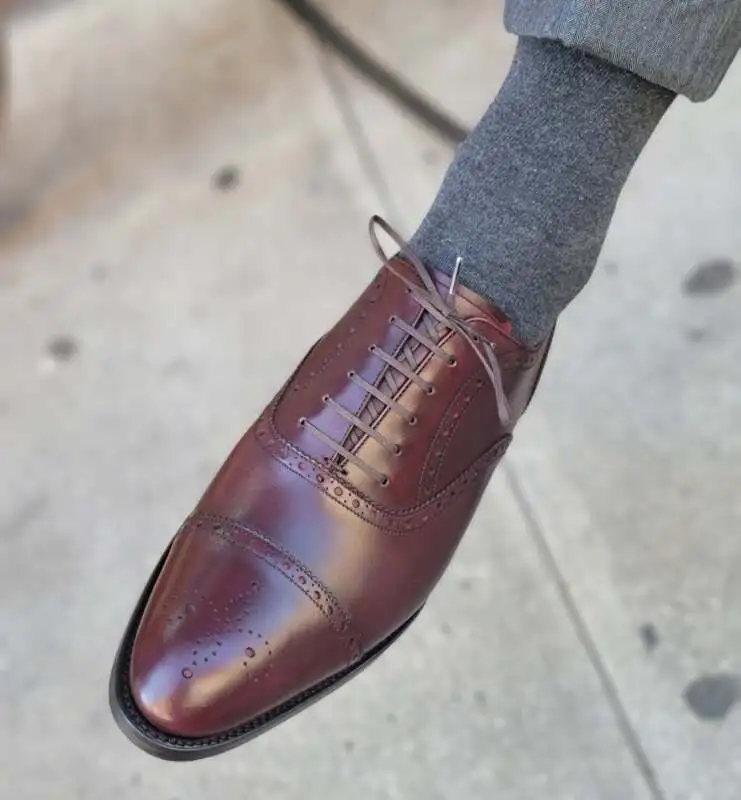
shoes are way too small in the front toe box area
those pictures are examples of why so many people have toe problems
the shoe front should get wider not narrow to a much smaller tip like shown
brannock claims i am 10-1/2 C
i find that 12D are too tight and hurt my toes
go bigger and then the heel would start slipping and cause blisters
actual feet and shoe makers as well as brannock are all different
we need a newer measuring device that works correctly and is followed by manufacturers
Thank you for sharing your thoughts
Sounds like we have similar sized feet. The only brands of shoes I can wear these days are brands that offer shoes made with generous toe boxes, and the shoes tend to run fairly large for their marked sizing.
Many years ago, a shoe salesman once told me, “You have to work with a shoe.” I have found it impossible to just buy a pair of shoes, and have them fit comfortably right from the start. I usually have to add some combination of heel cushions, innersoles, and/or orthotics, such as Superfeet. Often I have to stretch the shoes in the ball through toe area to get my toes comfortable.
My shoes do slip a little in the heel, but fortunately, they don’t cause me to have blisters. Overall, I do like to wear my shoes on the loose side. My feet tend to swell quite a bit during the course of a day, so the loose fit is the only way I can wear shoes. I will always rather have some heel slippage, then have squashed toes, which is so totally painful…!
sad fact is that even mondopoint system allows so much variance in shoe last length that… same model shoe from same manufacturer but different year… might be 12mm shorter/longer and its all in “spec” its 1.78eurosizes meaning… meaning you might end up going from nicely fitting shoe with thick sock to shoe that doesnt fit at all…. measuring would be nice but manufacturers have dropped the ball ages ago when they did the math, of shoe width,ball girth,heel width, instep girth and shoe length produces so many variables they would end up spending “millions” just to house the lasts…
exactly, there is no science, fool-proof way of sizing. Anything that says that it is ‘the standard’ or ‘fact’ is a lie. Fit/size is altered by way too many factors.
Sensible (and accurate) as usual. I started wearing properly fit shoes, aka comfortable ones… yes, you guessed it, when I started buying JFPs …
Life is better when you get access to “the knowledge”… 😉
brannock decice ruined ny feet
should never have trusted a shoe salesman
and learned to late to research for myself firstr
Thanks for sharing Joe, I am with you! That is why I try to educate.
I think the problem is compounded by the fact that manufacturers make size 9 shoes in different lengths and different shapes.
That is because there is no universal standard. ‘Size 9’ is just an idea. And if they were all the same, shoes would be very boring.
Just because some fool is cramming his damaged feet into a shoe 3 sizes too small doesn’t mean the device should be tossed. Honestly. “Thousands and thousands”…
The device shouldn’t be tossed but it should also not be a ‘this is my size because the brannock said so’. And pretty sure I stated just that in my summary paragraph. It is a guide, not a magical fact device
Maybe I am just lucky but this has worked for me. I look at the shape of the last on website photographs. I will look for what appears to have a low volume instep with a narrow waist. Then I will reach out to the shoemaker to find out the insole length of varying sizes. (So what has worked for me is the last appearance, insole length of 27cm in the narrowest width.) My first experience many years ago was at an Allen Edmonds store when I was put into a very comfortable 9B in their 65 last. Carmina and TLB placed me into 7.5E; which, I would walk out these shoes. After sizing down to a 7E (based on an insole length 27cm), I no longer slip out of comfortable shoes. My foot length is 26.4cm. I know it is complicated but am I on to something or am I just lucky?
you sound like the perfect case of trial and error. Most people want gauranteed fit based on simple ideas when feet are not simple nor are lasts. That is why the Brannock cannot tell the full story. But you did what is logical i.e. reasearch, reach out to the shoemaker, hope for the best on the first try and worse case, you exchange once. That, to me, sounds like the realistic way to go about things, understanding that there is always some trial and error.
You are once again spot on. I am a13 left foot and 12 right foot on branock. I have flat feet apparently narrow and low instep. Despite all this I’m probably more comfortable in a U.S. 12 D. I was measured and had a pair of bespoke shoes made by a highly recognized British shoe company. It was for my daughter’s wedding in 2020. To my shock when I received them they were about a size and a half too big. I returned them and several months later received a new pair about 1/2 size too big. Then Covid came and I my attention shifted elsewhere. Long story short they are in my closet unworn. I guess some day I will get some winter socks and take them for a spin. Better big than tight.
Thanks for sharing Nelson, I always appreciate your input! Still haven’t forgotten the patent loafer post lol 😉
Hi
So how does someone measure their feet correctly? Thank you
I actually don’t like using measurements to ascertain size. Meausurements only take into account certain aspects but tell nothing of what the person likes. Two people might measure the same but one likes shoes loose and one tight and they will take different sizes. What’s best is comparing against what you already have and finding advice online about similar fit to the brands in question. That is how I size people and have a very low return rate.