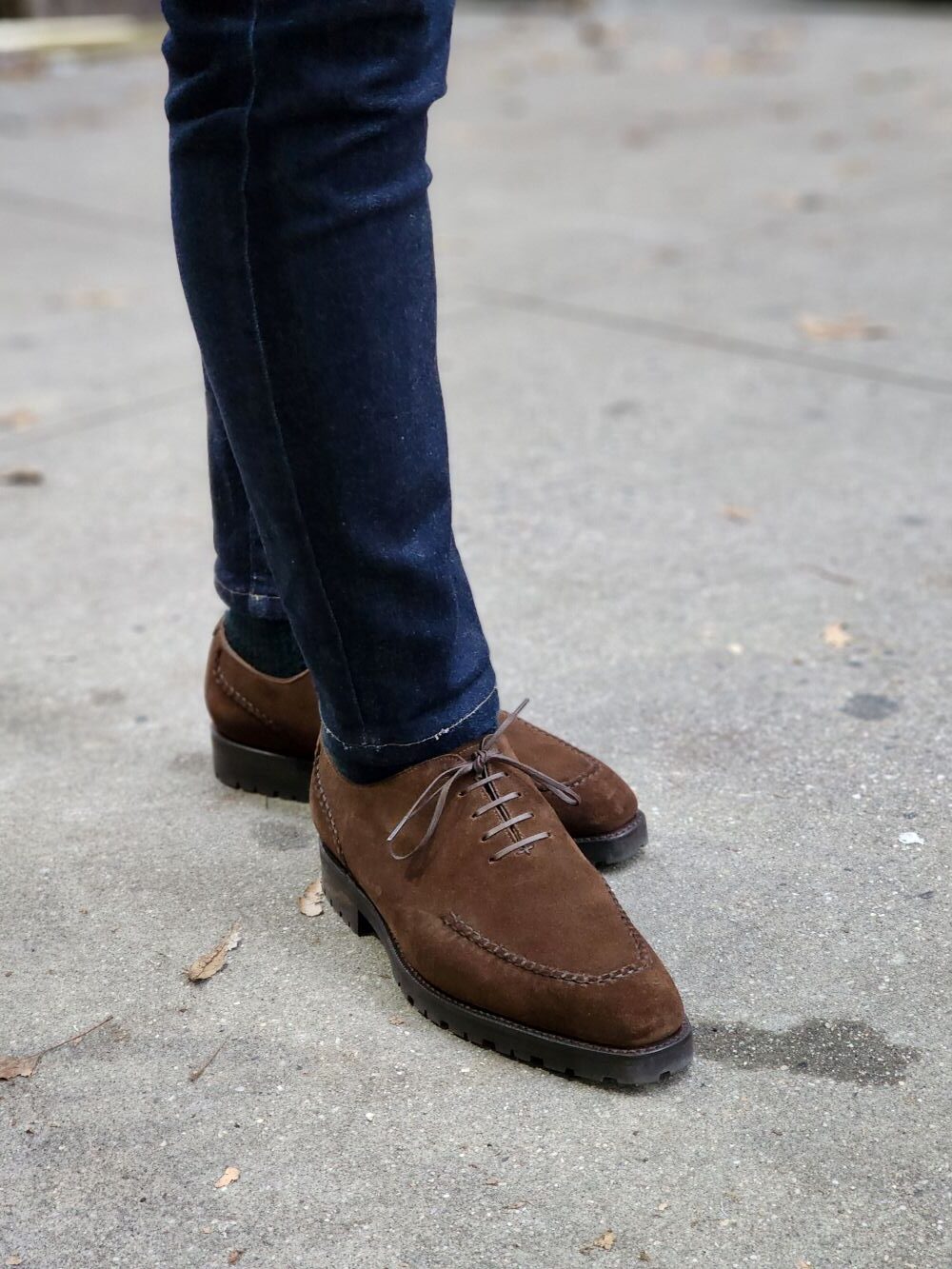
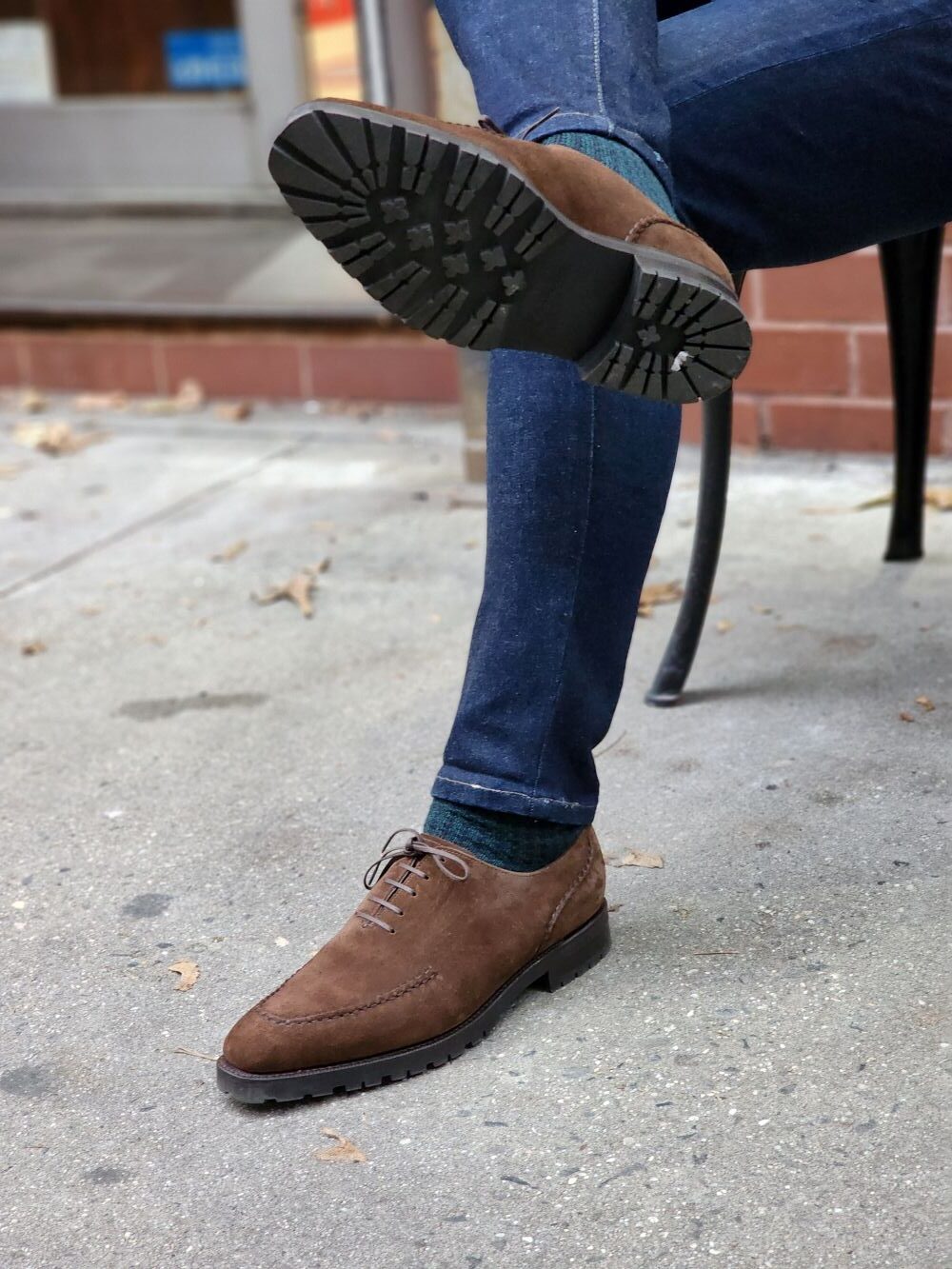
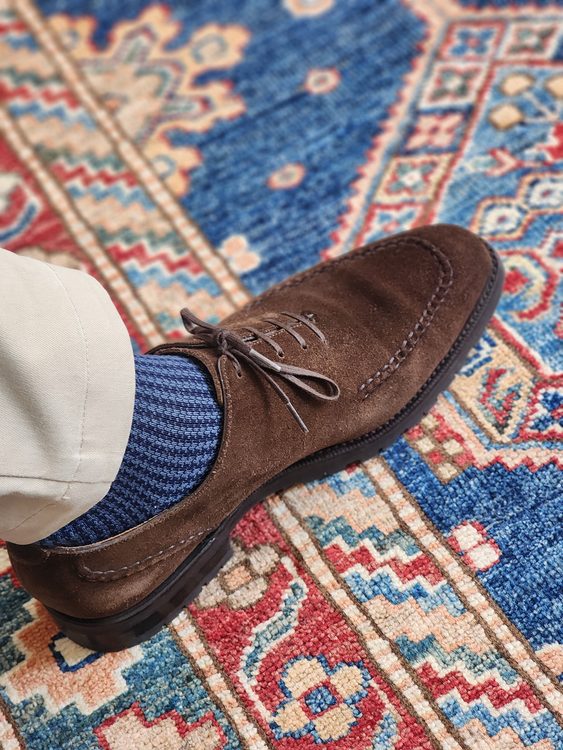
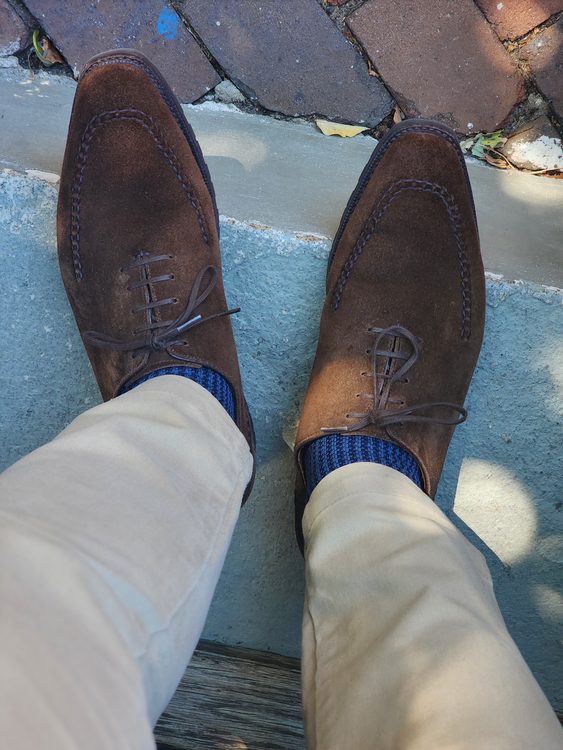
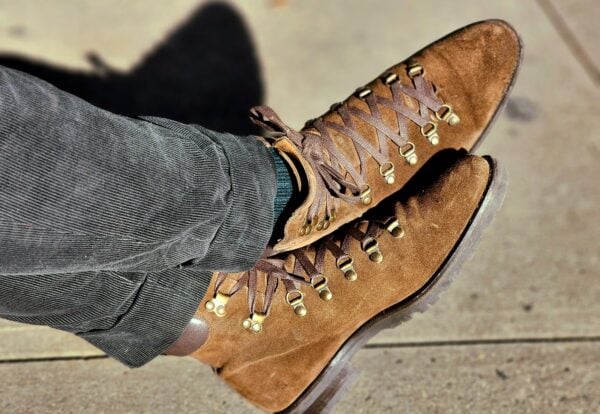
The best shoe to wear in the rain is any model in dark brown suede with a rubber sole. Hands down. That can be an oxford, a loafer, a monk strap, or, my favorite, a pair of Chelsea boots.
Now, tell someone you’re going out in the rain in suede and watch how quickly they tell you you’re about to ruin your shoes. It’s one of the biggest misconceptions in the shoe world. And like most blanket statements about shoes, it falls apart the second you ask one more question: What suede are we talking about?
If you’re talking about a thin, delicate sand suede butterfly loafer that was ideally made for summer, I’d definitely leave it at home. But if you’re talking about my dark brown suede Chelseas with Charles Stead Repello suede, I’ll put them on specifically because it’s raining. There’s no contradiction there. The two shoes have about as much in common in bad weather as a bright tan calfskin Oxford and a black grained leather boot.
The ironic part is that we seem capable of making that distinction with smooth leather. For some reason, with suede, everybody throws the whole lot into one bucket and bad information spreads as quickly as a forest fire.
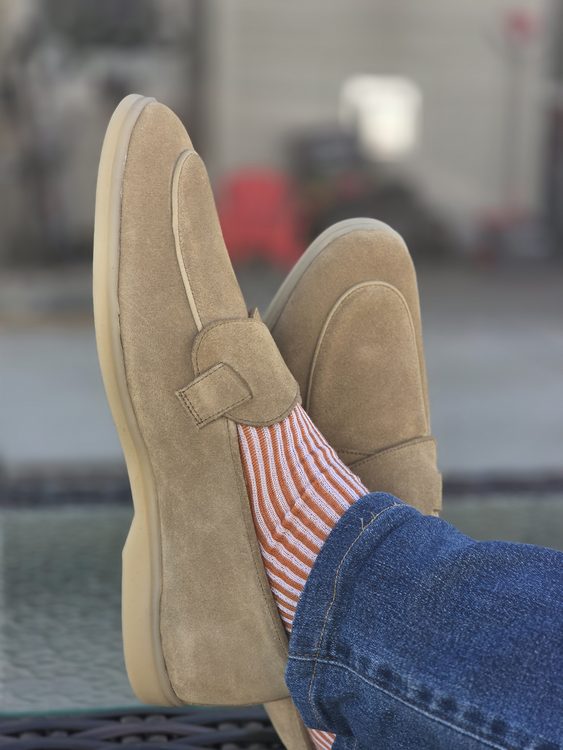
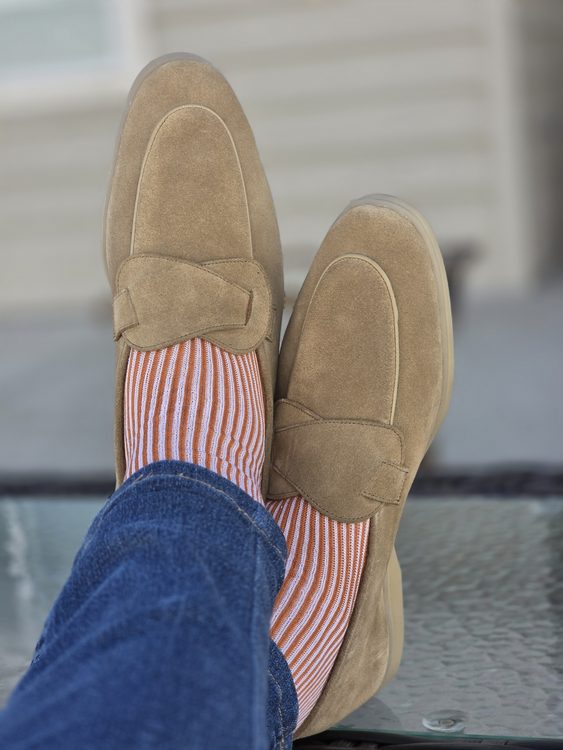
Light suede and dirty rain are a bad combination
Since moving to Idaho, I’ve discovered that it can rain and leave my car considerably dirtier than it was before it rained. I didn’t have that same problem in New Jersey. Sure, the car was not as clear prior to raining in NJ, but here, in Idaho, the wind picks up dust; it gets everywhere, and when the car dries, you can see exactly where the drops landed. Imagine that on a pair of light sand suede shoes.
That’s why I don’t wear light suede in the rain. A lot of what people blame on the water is actually the dirt that comes with it. Then you’ve got the pavement, whatever gets kicked up from it, and the filthy splash you didn’t see coming. On a pale shoe, you can see every bit of it. On a dark brown suede, the issue is less severe, if at all.
And this isn’t exclusive to suede. I wouldn’t wear a bright tan calfskin shoe on that same day. I’d wear black. Yet nobody sees a water-mark on a tan Oxford and announces that calfskin can never be worn in the rain. Somehow that’s exactly the conclusion we came to with suede.
There’s also a difference between a fine, delicate suede you’d put on a dressy summer shoe and a heavier suede you’d put on a boot. Some of those thin, plush suedes are lovely. I still wouldn’t pick them for a wet walk through town. They were made for a different job.
Good suede and cheap suede are not the same thing
People talk about suede as if every shoemaker is buying the same material and just picking a color. They’re not. Even from the same tannery, a shoemaker can buy different thicknesses. And the suede on a boot meant to be worn hard can be quite different from what you’ll find on a lightweight summer shoe.
I’ve generally found English suede more robust than Italian suede, but that’s a generalization. There are substantial Italian suedes, too. You can buy good suede from tanneries like Charles F. Stead, Zonta, and Opera. You still have to know what you’re buying. An English name on the box isn’t going to tell you how thick the suede is or what finish it has.
Some suedes are treated at the tannery to resist water. That matters because a shoemaker buying material for a boot that people intend to wear day in and day out doesn’t want to hear that the first shower left it looking destroyed. It also doesn’t mean the finished boot is 100% waterproof. Those are two very different claims.
My favorite for rain is Charles F. Stead’s dark brown Repello suede. I’ve worn it enough to know what it can take. If I buy a pair made of bottom-of-the-barrel suede and it stains the first time I get it wet, I’m not going to blame every suede shoe I own. I’m going to blame the cheap suede I just bought.
Why one drop can look worse than a downpour
This is the part that surprises people. Sometimes it’s the one drop that lands squarely on your toe that causes more grief than the whole shoe getting soaking wet. The drop sits in one place, dries there, and can leave a ring. When the upper gets wet more evenly, it often dries more evenly, too. At least that’s what I’ve seen time and time again, even with good suede.
With smooth calfskin, I’ve had water spots stay visible after the shoe dried. On a good suede, the nap doesn’t show every mark the same way. I can often brush the shoe down once it’s dry and be done with it. That’s one of the reasons I’ll choose suede over smooth calfskin in the rain.
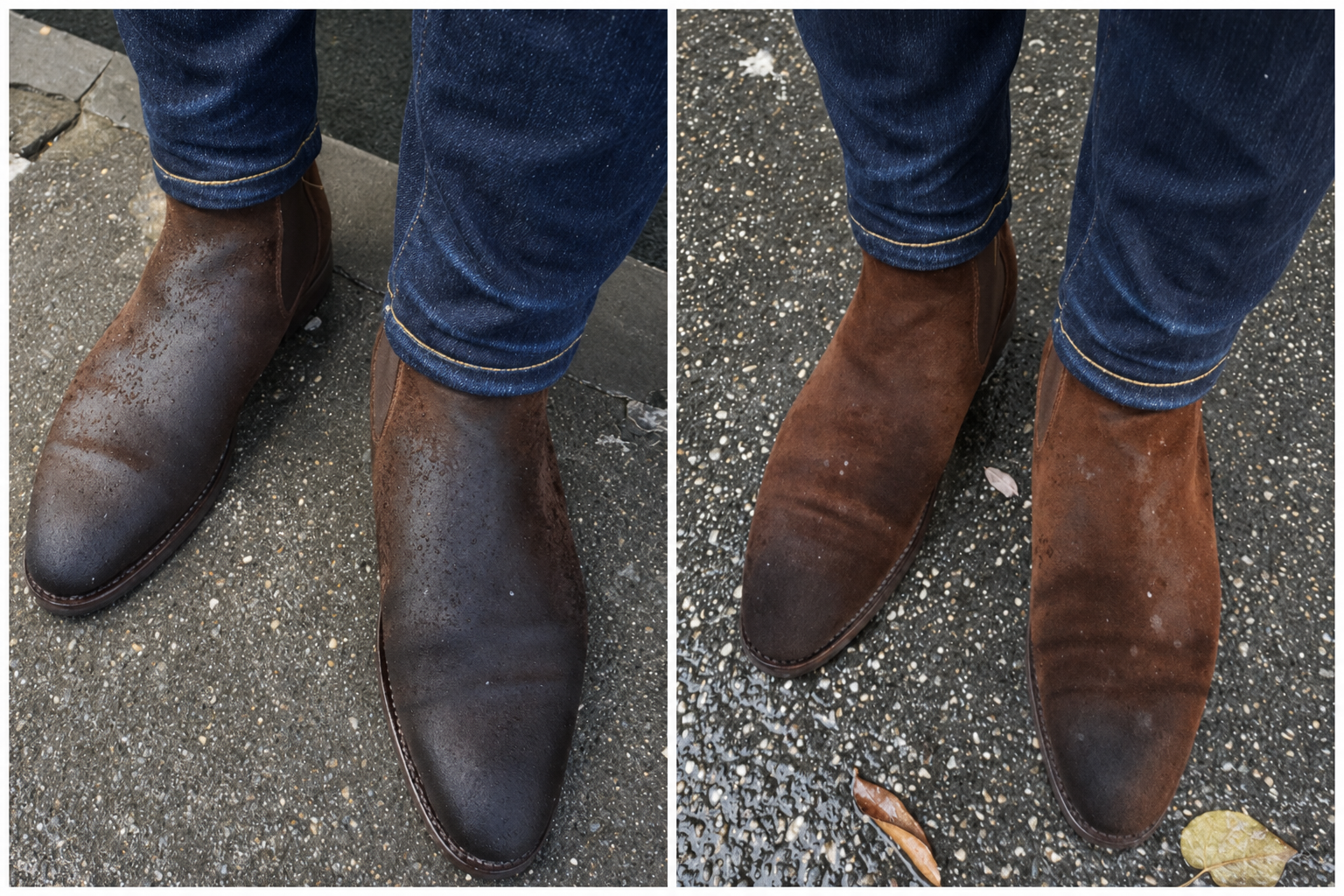
I’m talking about how the upper looks after it dries. A wet suede boot can look downright awful in the moment. Dark patches, almost black in places, and you’d swear the color was never coming back. Give it a chance to dry before you decide you’ve ruined it. More often than not, it will go back to normal, especially after a good suede shoe treatment.
The Paris hailstorm that sold me on snuff suede
I was on a scooter in Paris once when I got caught in a proper hailstorm. I was wearing snuff suede chukkas, and they got so wet they turned black. At that point, there wasn’t much to do other than see how they’d come out.
Less than an hour later, they’d dried evenly. No salt stains, no obvious marks. I was genuinely surprised. I’ve had calfskin show more evidence of rain after a few drops than those chukkas did after a hailstorm.
Snuff is still about as light as I go when I know I’m walking out into the rain. Would I expect every pair of snuff chukkas to do what that pair did? No. But that experience is why I don’t buy the idea that suede is some delicate thing you have to run inside to protect as soon as the weather turns.
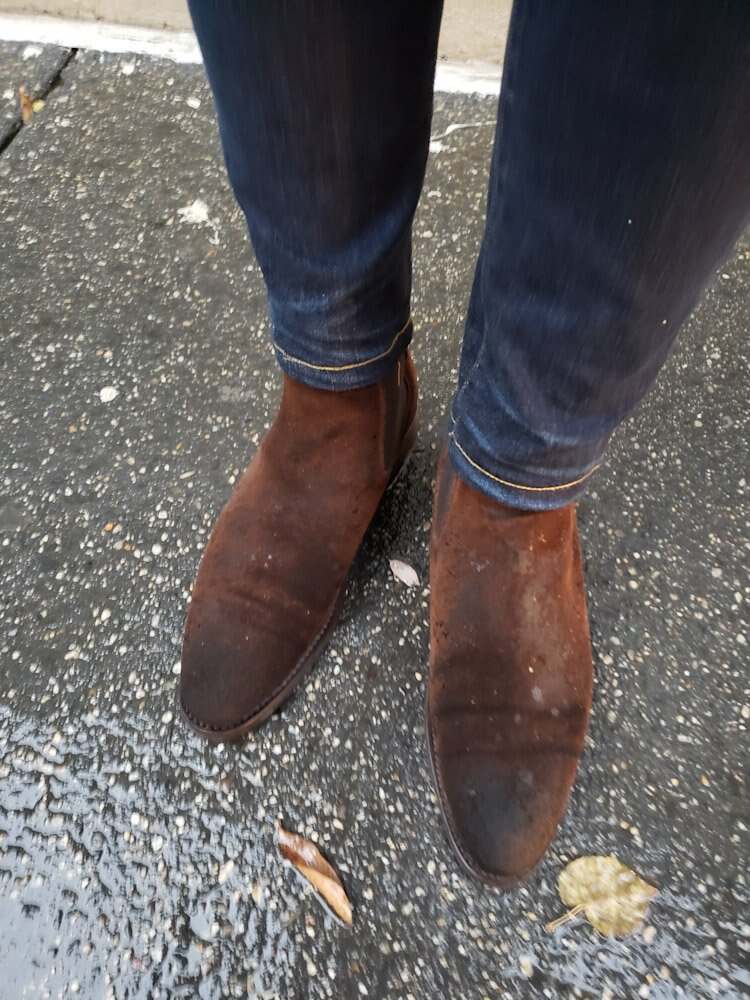
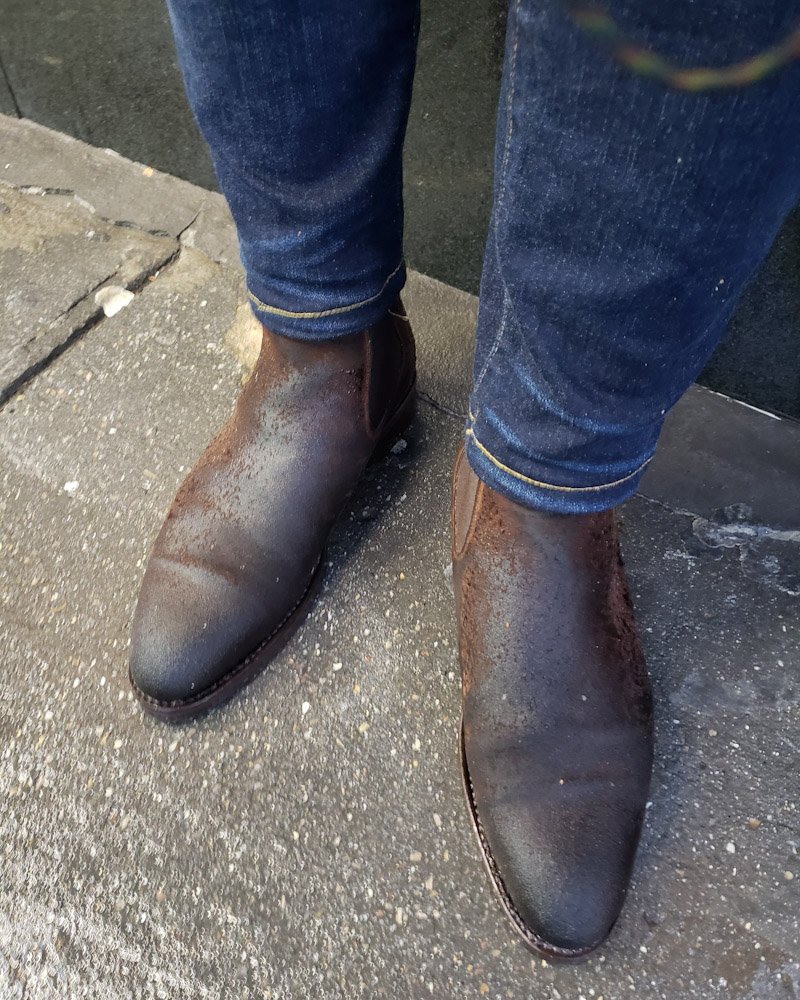
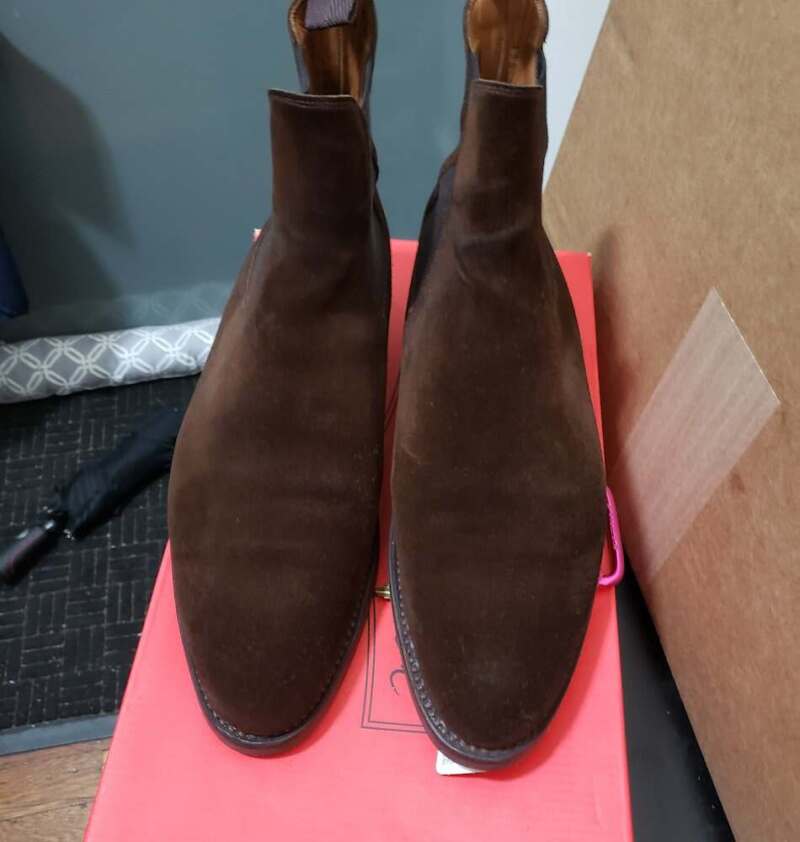
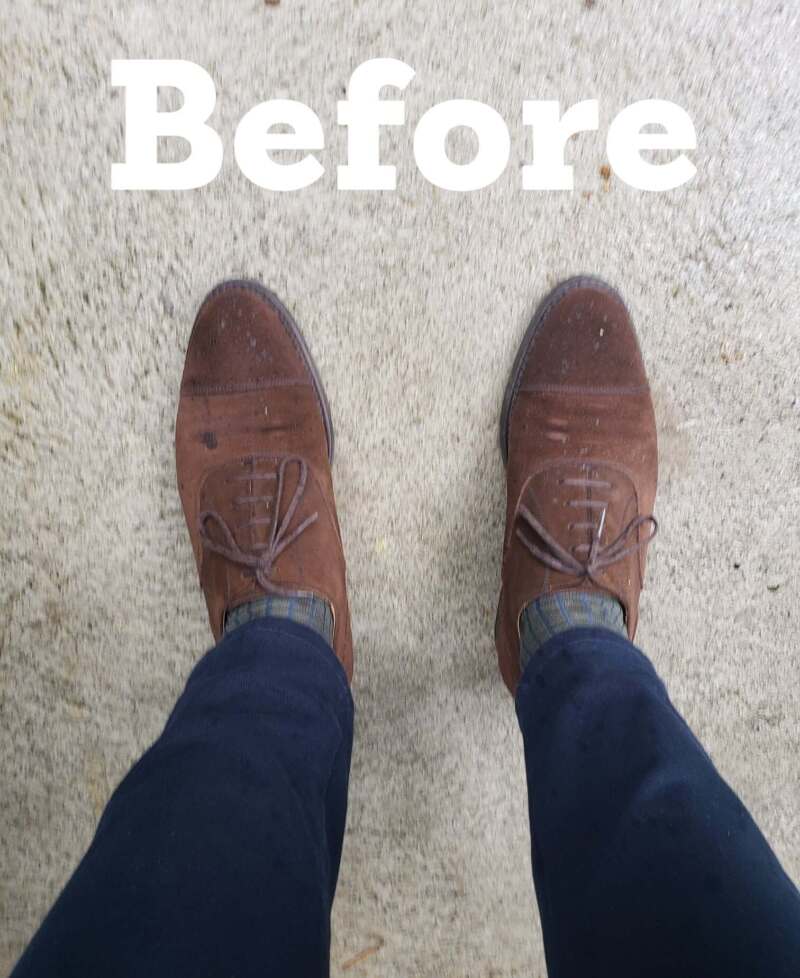
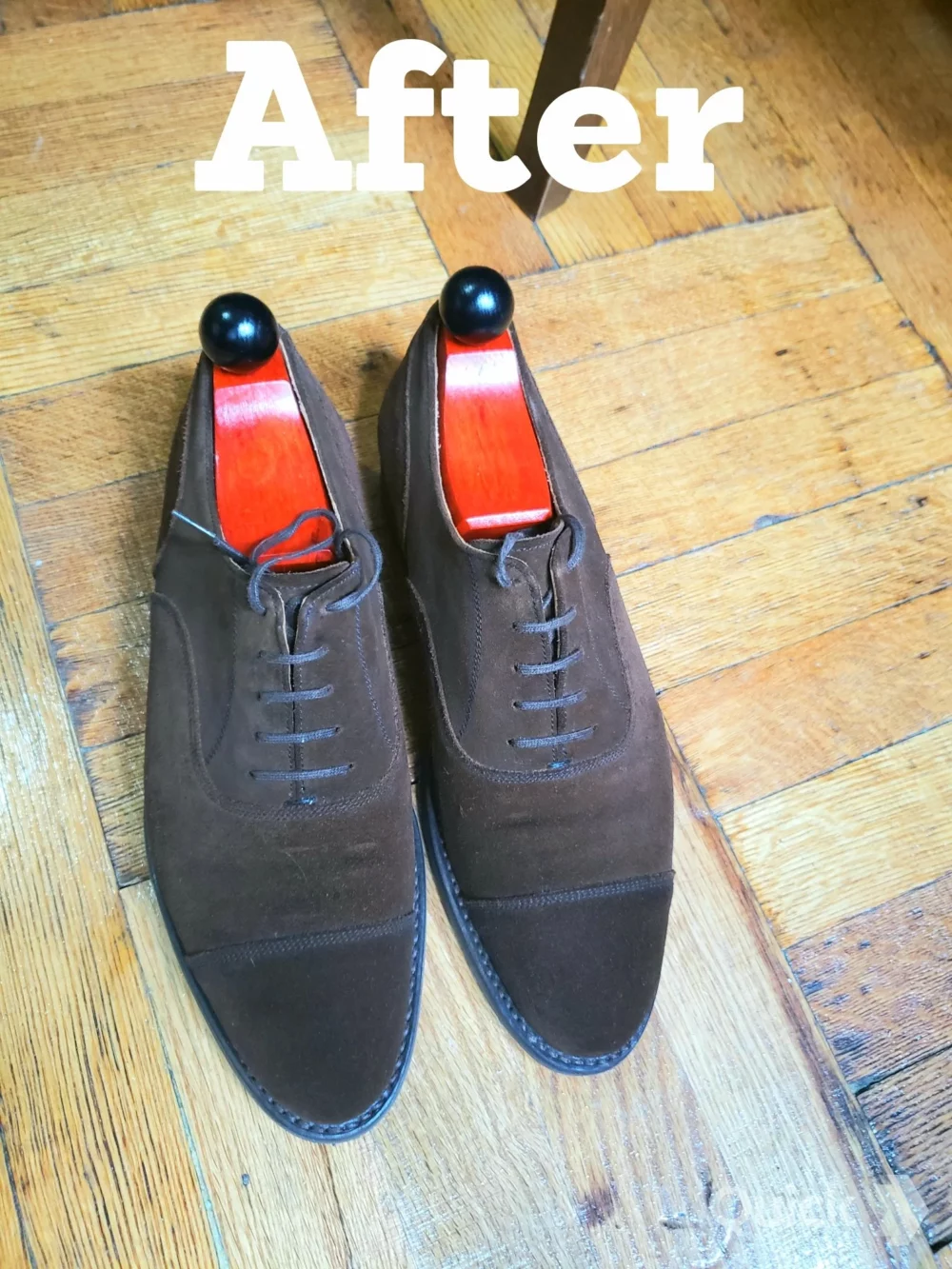
The photos above are from a different downpour. Those are dark brown Stead suede boots. You can see what they looked like as the rain started, how dark they got once they were drenched, and how they looked the following morning. I put shoe trees in them, let them air dry overnight on their sides, and gave them a brush down in the morning. I didn’t even steam them.
That last photo is the one I’d show anyone who thinks the first sign of rain means the end of a suede boot.
If dark suede is so good, why not black?
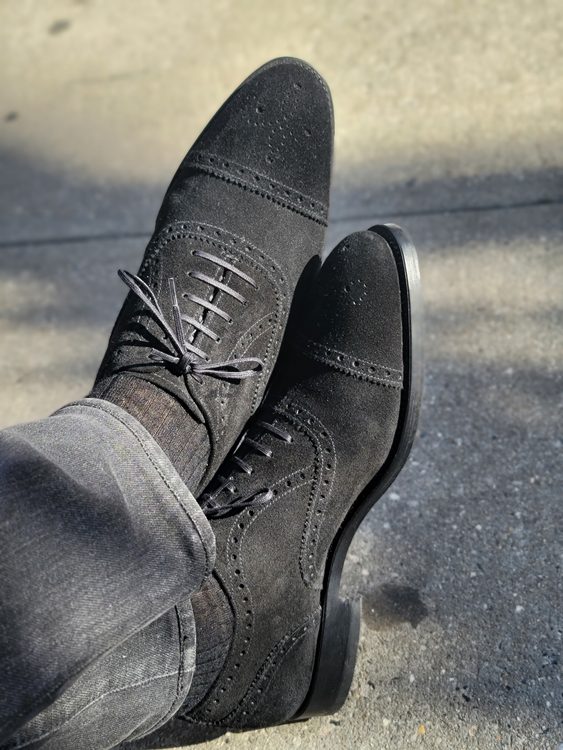
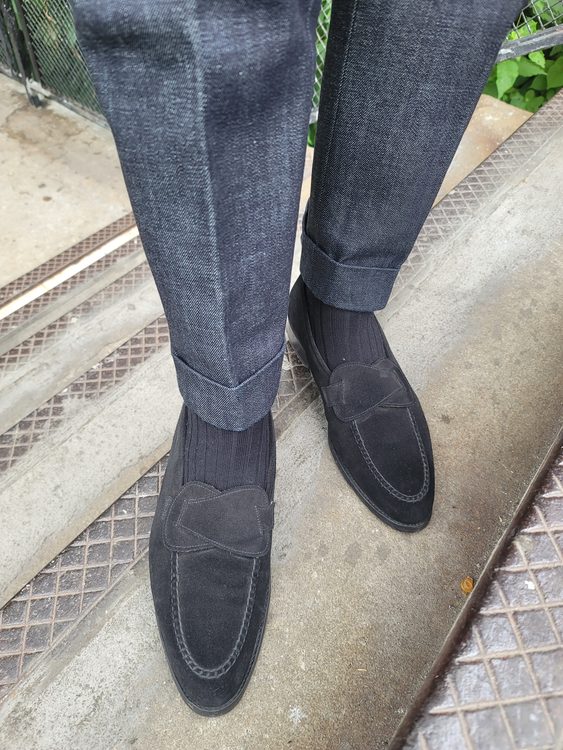
You can wear black suede in the rain. I usually don’t because I like my black suede to stay black. That rich, deep color is half the reason I bought the shoe. After enough wet outings, it can start to look a little tired, and I notice it more on black than I do on dark brown.
You can bring some of that depth back with a suede recoloring spray. That’s a different job from spraying a shoe to protect it from the rain in the first place. I don’t bother with a protector spray on the dark brown Repello I wear in the rain. I’ve never felt I needed one.
If I’m standing at the door choosing between dark brown and black suede, I’ll take the brown. If all I have is black suede, I’m not changing my plans over it; it will survive!
Where roughout and Waxy Commander fit in
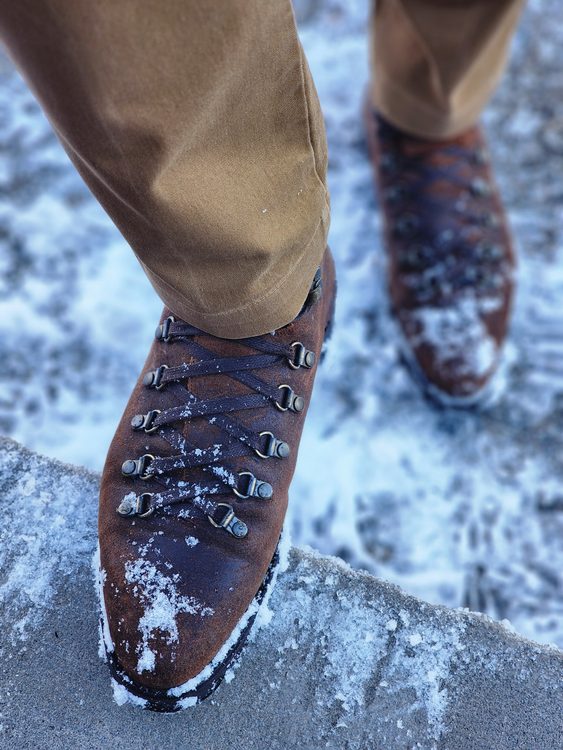
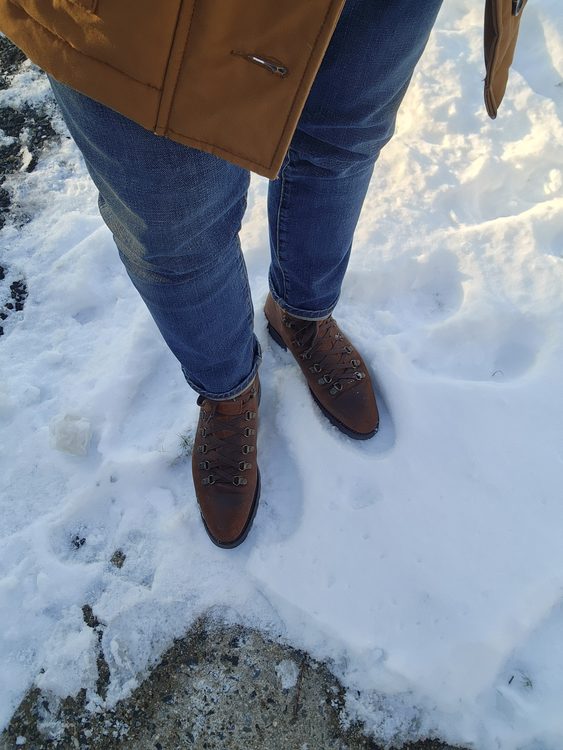
One thing that’s changed since I first wrote about this is how much more roughout and Waxy Commander I’m seeing in the dress shoe world. Most guys are still more likely to own it in a Chelsea or a lace-up boot than a dress Oxford. And a rugged Chelsea is exactly the sort of thing I want when the weather looks miserable.
Waxy Commander is a good example of a leather I wear without worrying about every little mark. It’s got a different look from a dressy brown suede, and that affects when I wear it. With a dressier look, I’d still reach for the cleaner-looking dark brown suede. If I’m putting on a boot for a wet Saturday, give me the Waxy Commander. And even better yet, if it is snowing, then definitely the Waxy Commander is going to hold me down better than nearly anything else.
You don’t need to go out and buy a special leather just because it rains where you live. A good dark suede boot with a rubber sole already does the job for me most of the time. But if you want something that looks right with jeans and that you don’t mind getting knocked around, Roughout and Waxy Commander are well worth looking at.
The rubber sole is half the answer
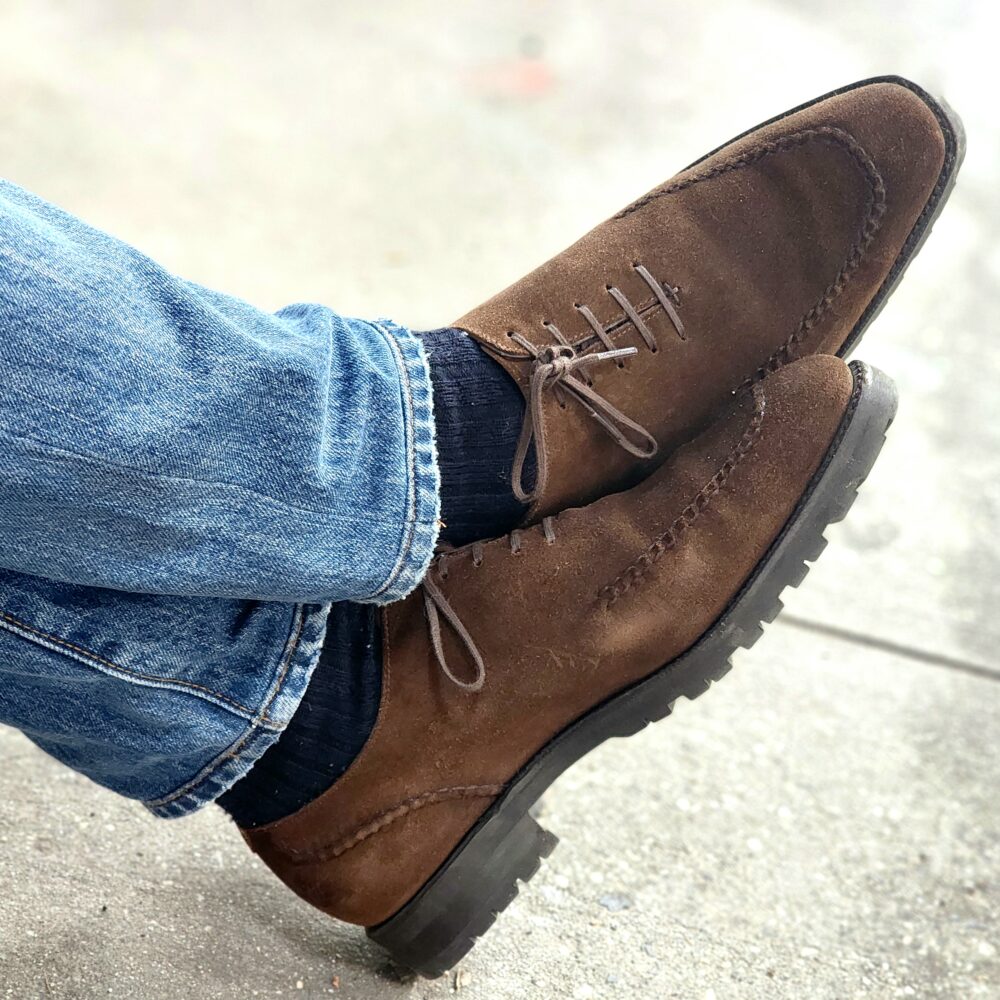
People hear me say “wear suede” and forget the second half of the sentence. Put a rubber sole under it.
I love a leather sole. I’ve spent enough time defending them that nobody’s going to accuse me of being a rubber-sole convert. But walking on wet pavement day after day is a good way to wear through a leather sole quicker than you need to. If I know I’ll be walking around in the rain, I’d rather let rubber do that job. I get into the trade-offs more in Leather Soles vs. Rubber Soles.
This is why I don’t get hung up on whether it has to be a Chelsea, a chukka, or a shoe. A dark brown suede loafer with a rubber sole can work for the day you’re having. I tend to grab a Chelsea because that’s what I like to wear when it’s wet. The material and the sole are what I’m looking at first.
And if you don’t like suede, fine. Wear a dark grained leather or black calfskin with a rubber sole. Those are the two I’d look at before reaching for a bright tan shoe and spending the whole walk checking whether I’ve spotted the toes.
Rain is one thing. Standing water is another.
When I say you can wear suede in the rain, I mean you can walk down a wet street in it. I don’t mean you should step into a puddle deep enough to cover the upper and then be surprised when your socks are wet. A suede upper can come out looking fine after a soaking and still have done a lousy job of keeping your feet dry.
The same goes for wet grass. If you’re going to spend the morning crossing a field, wear boots built for that. A rubber sole doesn’t turn a dress boot into a rain boot, and neither does buying better suede. Use a bit of common sense about where you’re going.
What I do when I get home
If the boots are soaked, I let them air dry. With the pair in the photos, I put shoe trees in and laid them on their sides overnight. In the morning, I brushed them. That was all they needed.
If I brush the suede and the nap still looks flattened or uneven, I’ll give it a light steam and brush it again. I’ve recommended steaming before because it can help when the suede needs it. But if the boots already look good after a brush, what am I steaming them for?
The mistake is looking at a wet shoe, deciding you have a stain, and trying to fix it before you even know what’s there. Let it dry first. You might find that what looked like a disaster when you walked in the door was just a wet shoe.
So yes, wear suede in the rain. Just be honest about what you’re wearing and where you’re going. If you’re asking me what to put on for a wet walk into town, it’s the same answer I started with: dark brown suede, rubber sole. If you’re asking me what to wear to walk through a flooded field, why are we even talking about dress shoes?
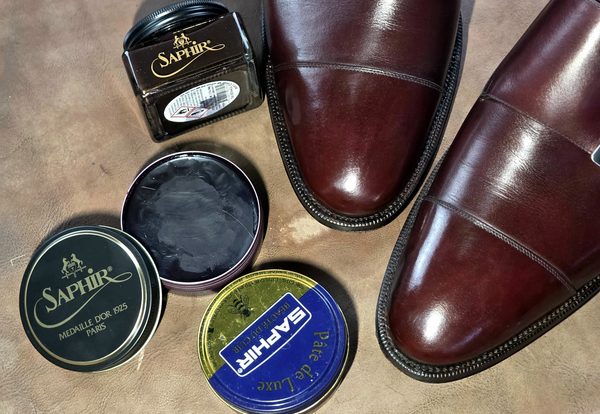
If your suede shoes could use a bit of attention, I carry suede brushes, erasers, and cleaners at The Shoe Snob Shop. If you’re looking after Waxy Commander, I also carry the Saphir Oiled Leather Cream I use on my own boots. Watch a tutorial here on how I used the Oiled Leather Cream to clean my own boots.
—Justin FitzPatrick, The Shoe Snob
Shop · Marketplace · Patreon






Justin, I had another idea. Like lately EBay is full of shoes that looked ripped off stock or instagram photos from people such as your brand and Gaziano Girling to name a few (that I could instantly recognize). One thing they have in common are that they are all from Pakistan and show pictures of totally handmade shoes. However no one has done a review of this.
They all have a price point of $170ish. They promise gyw, which is just BS. But someone needs to do a review! So how about it? I think it would be amusing, educational and also to warn people what you get when you order something like this. Like review your own knockoff? Then get Tony Gaziano to see if he can recognize his own knockoff (which I’m 100% sure he will).
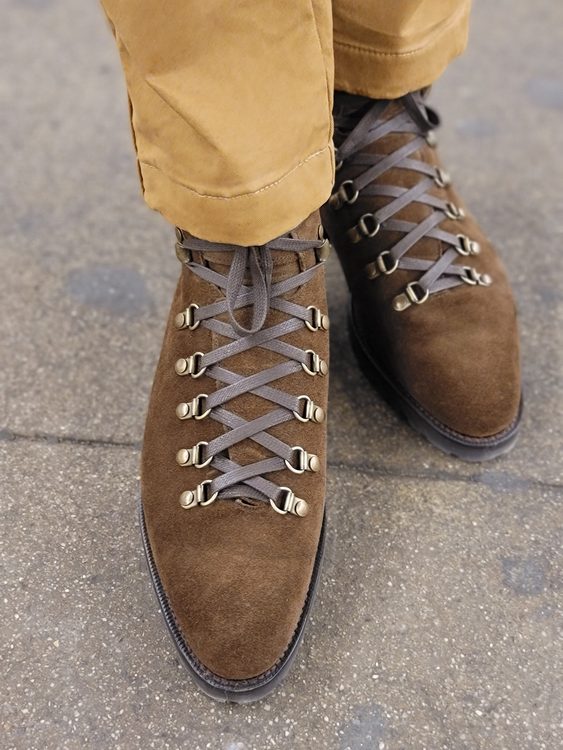
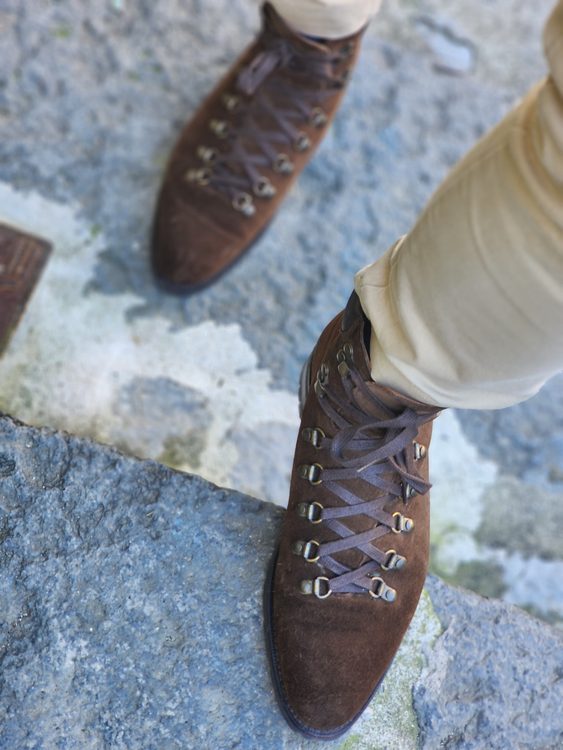
Justin, is it possible to know where you bought these brown suede boots? thks
Yes of course they are by my brand J.FitzPatrick footwear http://www.jfitzpatrickfootwear.com
Hello Justin,
I saw on youtube that you purchased meermin suedes for rainy weather.
I am considering purchasing a dark brown suede chukka for rainy days as you suggest, but feel unsure about what good suede is.
Did you find meermin suede to be okay for rainy days without use of additional chemicals? In your opinion, would a step up in price to Loake 1880 (or higher) be worthwhile? Sorry for asking about competitor brands..
No worries Sunny. I havent actually worn the Meermins but if they use Charles Stead Repello suede then they will be just fine. English shoes usually use good suede too. Loake should also be fine
Hehehe… Great ones…. Just waiting for tariffs (UE’s) to drop… ;
let’s hope soon! I would love free trade to the EU to reach all of my customers again!
I have CF Stead Repello suede and love it. However I also have Horween Chromexcel and find it very resistant to water and snow and chemicals – as a “oil stuffed” leather. Also as you mention grain leathers also work well and are a staple of English country side brogue shoes and boots.
Thanks for sharing Brian. Indeed those other leathers you mention work well too
This post reminded me that my brown suede whittiers are one of my favorite shoes and it’s time to bust them out of the closet now that the weathers cooling down.