
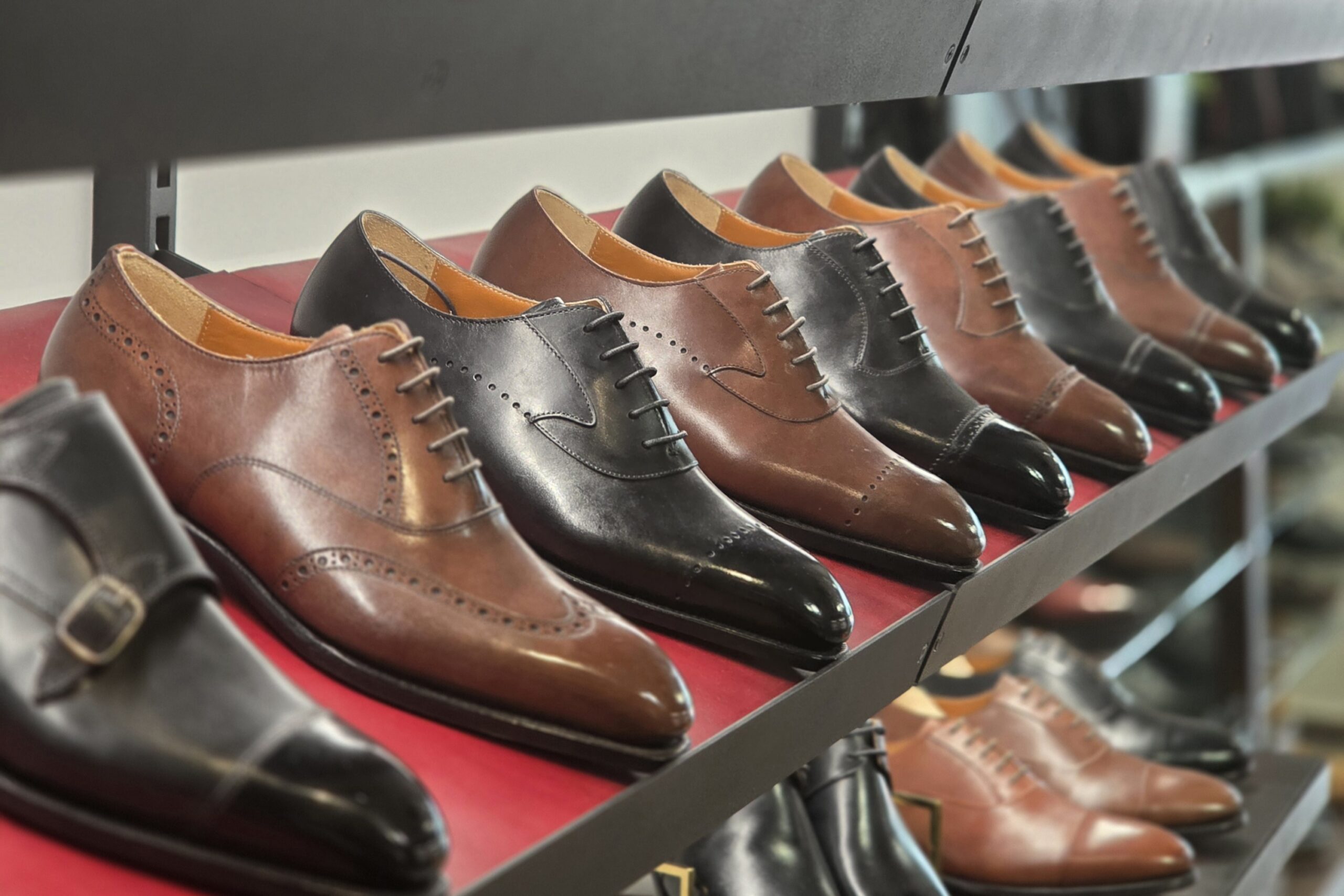
Is European Shoemaking in Decline? A Hard Look at the Industry
Over the last few years, I’ve found myself asking a question that honestly makes me uncomfortable:
Where are the new European shoemakers? Is European shoemaking declining?
This isn’t a nostalgic rant, and it’s not meant to diminish the incredible legacy Europe has built in shoemaking. But as someone who works directly with factories, organizes international shoe events, and lives inside this industry daily, it’s a question that keeps resurfacing — and one that deserves an honest discussion.
Ten Years Ago, Everything Felt Different
If we rewind a decade, European shoemaking was on fire.
Brands were emerging, internet buzz was real, and names that are now well-known were actively growing into their identities.
There was momentum. There was excitement. There was a discovery.
And today? I struggle to name genuinely new European shoemakers breaking through in a meaningful way. Even more so, it is more and more that European factories are opting for their own brand of shoes and doing less private label.
Yes, there are still excellent brands. Some long-established names continue to produce beautiful work. A few lesser-known makers exist quietly under the radar. But the wave — the sense of new energy — feels largely absent. Especially since the Pandemic of 2020.
Meanwhile, Asia Is Rising — Fast
At the same time, we’ve seen an undeniable rise in Asian shoemaking. In 2020 alone, a bunch of new brands hit the scene.
China, Vietnam, India, Indonesia — these countries aren’t just producing shoes anymore. They’re producing culture, craft, and in many cases, quality that rivals Europe at significantly lower prices.
That matters.
When consumers can buy footwear of comparable quality for half the price, it becomes increasingly difficult for European makers to justify their positioning — especially when “Made in Europe” alone no longer carries the weight it once did.
The Factory Reality Nobody Likes to Talk About
One of the biggest issues, in my view, sits at the factory level.
Most traditional European factories no longer want to produce for smaller independent brands. Wholesale and private labeling are slowly disappearing or making it impossible for small brands to even get a foot in the door. This is being replaced by a focus on factory-owned retail brands, where margins are better, and control is higher.
From a business standpoint, I understand it completely. From an industry standpoint, it’s deeply troubling and makes me fear for the future where all that is left are heritage brands and small independent makers/brands cease to play ball.
Because if small designers can’t access European factories, where do the next great brands come from? All that is left is brands with Private Capital money behind them, producing low-quality/high-margin brands marketing to the masses as ‘handmade, soft-luxury’ rubbish.
Starting a shoe factory today is borderline unrealistic. The capital requirements are massive. Skilled labor is aging out. Younger generations aren’t lining up to work in factories. And training new workers takes years — time and money, most businesses simply don’t have.
Consumer Behavior Isn’t Helping
We also have to be honest about ourselves as consumers.
We wait for sales. We chase discounts. We reward cheaper alternatives. And while that behavior is understandable — I’m guilty of it too in other industries — it has consequences.
Factories can’t raise wages without raising prices. Raising prices makes shoes harder to sell. And so the cycle continues.
Add in Conglomerates, and the Picture Gets Worse
Another uncomfortable truth: large luxury conglomerates are buying up factories, tanneries, and production capacity across Europe.
That consolidation may keep manufacturing in Europe, but it removes opportunities for independent makers and narrows creative diversity. Over time, that leaves us with fewer voices, fewer risks, and fewer reasons for innovation.
So… Is European Shoemaking Dying?
No. But it is shrinking in ways that concern me.
I don’t see many new factories opening. I don’t see many new European brands taking meaningful risks. And I don’t see strong incentives for either to change under current conditions.
I would love to be wrong. I would love to see a resurgence in dress shoes, craftsmanship, and demand strong enough to fuel growth again. But looking at the broader trends — casualization, sneaker culture, comfort-first consumer habits — I’m not convinced that moment is coming anytime soon.
I love European shoemaking, quality, and style. It is what inspired me to become who I am. So this is a post of concern for something that I hold a passion for. A concern I see for the entire industry. It won’t materialize in 1 or 2 years, but I truly question where the shoe industry will be in 10 years.
An Open Question
This isn’t meant to be a definitive conclusion. It’s an open conversation.
Do you care where your shoes are made?
Does European production still matter to you?
Or is quality at the right price enough, regardless of geography?
I’d genuinely love to hear your thoughts.
This article is adapted from one of my earlier podcast discussions. If you enjoy these deeper, industry-focused topics, let me know — I’d like to explore more of them here on the blog.
—Justin FitzPatrick, The Shoe Snob
Shop · Marketplace · Patreon





Thanks for this talk. I love yoir dedication to the craft, and appreciation of other shoemakers.
My pleasure Scott and thank you for saying so
You’re absolutely right I’m not a rich person but I do own three pair of churches shoes the quality is there I don’t call Hans too and and I have to say man to get quality shoes you the only one but I like to hear from but you never send me anything to buy your shoes the British the Europeans been all over the world they started people with bad for it they started the best you can get and people still don’t understand because you right they want to be cheap send me stuff where I can buy your European shoes I wear a size 10 thank
Thank you for sharing Wali
Great episode. I believe the makers are struggling all over the world. Here in Mexico, the nearshoring for the US market is flooding the industry with their products and factories making nice Goodyear welted productions now are focusing on (also welted) big volume orders from these brands, leaving no space for new brands to come in. We have a small workshop where we attend small companies or creators, if you are interested please just send mi an email to [email protected]. You can see more about us in http://www.adroshoes.com
Thank you for sharing Bruno
Hi Justin…
I think you are the answer to your own question here.
It is not just that you say “I’d not wish to own a shoe factory”. You have also set up your own shoe brand based on the idea of controlling only the design and marketing, while the production is outsourced to a lower cost country.
That is Spain in your case… but Meermin is taking it a step further, having their design in Spain and the production in China.
Other brands are on the same track – as Cheaney, Loake, Grenson and Tricker’s are now shifting some production to Asia.
As Europe and the US are becoming richer, these places are becoming less suitable for labour-intensive production of any kind.
It just does not make sense for rich people to do manual labour (and I count every citizen in Europe as rich, although some may not quite feel like it).
Perhaps nobody has contributed more than Apple to making the outsourcing model respectable. Its iPhones are famously “Designed in California” but produced in China. One may or may not like their products, but the quality has been on display for all to see – for more than a decade now.
Customers are unwilling to pay much more than necessary, for a given level of quality. Perhaps a few will always believe that “Made in X” is great… but this is not sustainable. Especially, the younger generations are not fooled. They have little loyalty to legacy brands and have felt the quality that can be attained in Asian products. They may even have travelled and found people in faraway places to be just as serious and hard-working as those at home… if not more so.
In principle one could perhaps imagine more robots to the shoe industry, which would mitigate some of the cost issue. That is how the car industry in Europe keeps going…
But as I understand it, shoe making is hard to automate. Besides, the Chinese are really good at building and operating robots, too.
The latest news now in 2025 is that car makers in Europe struggle enormously to compete on electric vehicles. In recent months, Chinese BYD sold three times as many cars in the European market as it did a year ago… also surpassing its U.S. competitor Tesla for the first time.
I think the way forward for production in Europe (or the US) is either focusing on the luxury segment, or securing government support. Governments can help in ways such as mandating that military kit must be produced at home.
Either way, I would also not like to have a factory in Europe… of any kind.
Thanks for sharing Sven, you hit the nail on the head. People in the ‘West’ look down on factory work as something ‘lesser than.’ It’s a shame really. Handwelted will rise, bespoke too, but factory production in the West will continue to decrease, that is how I see it. I hope to be wrong, but I doubt it.
Hi Sven, I can’t agree that “every citizen in Europe” is “rich”. That’s a very outdated point of view. For example, the following Asian countries have average salaries HIGHER than at least 5 European countries: China, Turkey, Cyprus, Israel, Kuwait, Saudi Arabia, Bahrain, Qatar, UAE, Oman, Japan, South Korea, Taiwan, Hong Kong, Brunei, and Singapore. Europe is NOT a rich continent, thanks to decades of decline and poor leadership.
Thanks for sharing Graham
As someone who worked for years in the industry for possibly one of the top British brands I agree in parts but want to take longer to reply…
But let me ask you first when you say European do you include the UK makers or consider European as only continental European brands…?
I would include the UK in that as I know many factories have been struggling to keep up in the last 5 years, often having 3-4 day workweeks.
Hi Justin
So generally I agree with it the welted shoe business had many challenges over the years with boom years inbetween …. and Covid and the obsession with sneakers( and men wearing tracksuit casual clothing and confusing comfort with style..) hsnt helped either concurrence is fierce and our stupid Western obsession to still look down on asian great shoemakers is stupid as well…..
However some brands are very healthy and make excellent shoes and will continue to do so so I can’t share the view totally… Edward Green John Lobb and CJ and GG to name only the top few do well… could always be better but they do well
Carmina is doing amazing and so do TLB mallorca from the iberian peninsula….. and France has some pretty impressive companies and stores … I am not saying its easy….but compared with for example Allen Edmonds a shame to let such a nice company rot to cheap ugly shoes or the dead Cole Haan we are doing pretty well in good old Europe…. Alden is the last lighthouse in the US that continues to inspire home and international clients….
Hello Andreas, thank you for sharing. I do appreciate your insights. While the Heritage brands will likely be the ones that survive, I can tell you that they have had some scares themselves. I know first hand after talking with many of the factory owners. Many British factories have gone down to 3-4 day weeks, which is unheard of in the last 50 years. So, while the big ones will likely stay standing, I will tell you that it is no easy feat. Especially as part of the biggest issue is a shrinking market. While Europeans still dress relatively ‘well’ in terms of conservative dress wear, I still see the modern urban styling slowly overtaking. The new Italians are not dressing like their fathers, grandfathers, etc. Same for the British. Casual and contemporary culture is eroding a lot. And if workplace dress codes never revert to leather soled shoes and suits, I fear that it will eventually become so small that the only ones left are the top heritage brands and smaller, niche brands will have a hard time staying relevant.
Well, I’ve been wearing quality leather shoes for more than two decades, my early choices were primarily Allen Edmond and then Magnani. It’s only in the last four years that I’ve really elevated my Shoe game. So I’m late to the game in terms of understanding the heyday of European shoemaking. All that being said, as a consumer, what I really care about is that the shoes that I got fit my style, are comfortable on my feet, and I feel like I got a good value for my money which doesn’t mean the least expensive option. I own Shoes from Gaziano And Girling and TLB, Mallorca and Carlos Santos, all of which I believe on their own factories. A lot of my closet does come from Asia and you can’t argue how incredible the shoes that they are producing are. No longer does made in China mean cheap. The artisanship is Simpli on another level and I’m not sure how traditional European brands can compete. Especially as you so know that no one is likely going to start a shoe factory today.
Thank you for sharing as always Michael. I think that the heritage brands will remain competitive and effective, but smaller, newer ones will have a hard time staying relevant unless they really offer a unique proposition
Hi
Trully speaking You are right. Im making bespoke boots in Poland. I would rather say its expensive hobby. Real shomakers are dying. A there is no one to replace them. Also customer group is shrinking. Also I can see how pandemic killed local cheap brands. Allmost all mass market shoes are from Asia and Turkey.
Im starting european brand like Blundstone to earn money to keep passion alive. Sad but make descent living of shomaking is impossible. High wages, no workers, high social insurance costs. Ideal recepie for succesfull busines:) But there are few of us who keep fighting.
Thank you for sharing Bart, I wish you the best of luck for your new brand!
Interesting observation. I wonder how much consolidation has hurt smaller brands. Do you think the quality of the leather the Asian makers use is the same quality? Do they have access to the same level of hides that the established European makers have?
Hello Drew, smaller brands are the ones hurt the most. Most of the heritage brands with strong history will remain, although, their sales are too affected. But the smaller brands will suffer the most as the market is oversaturated and the consumer base shrinks. As per Asian factories having access to quality leathers, well of course they do. We live in a capitalistic world. Who has the money, has the access. They just have to go to the leather shows like anyone else and place their orders. Many Chinese brands, for example, appear small to us here on the West, but they will have a ‘Chinese brand’ or cusotmer base that is 10-20 times the size of what we perceive them as. Twinkima.G is a good example of that. Maybe they will sell 1000 pairs a year to ‘The West’ and then 10K-20K to the Chinese market alone.
Got it. Thanks, Justin. Appreciate the insight!
Very few colleagues I know buy European-crafted shoes, due to the price-they tend to lean towards dress sneakers or mid-size brands like Cole Haan, etc.
Thanks for sharing Donald
It’s hard not to question whether many European shoemakers have relied too heavily on their heritage, sometimes in an overtly opportunistic way. Having worked in the shoe industry myself, I’m consistently struck by the lack of meaningful innovation. Asian brands deliver comparable—if not superior—results at significantly lower prices. In that context, it’s difficult to understand how brands such as Edward Green can justify a €1,400 price tag. Even so-called mid-tier brands like Carmina and Crockett & Jones strike me as overpriced.
It’s also simply untrue that European brands—aside from a select few—have access to better leather. They may have easier access, yes, but that does not automatically translate into higher quality. Even that advantage is likely temporary: it’s only a matter of time before Asian tanneries close the gap entirely, leaving no meaningful difference between European and Asian leather. Ethics may be a different discussion, but even there, conditions in Asia are far better than many people assume—or perhaps want to believe.
One aspect of shoemaking that I believe is still holding Asian manufacturers back from fully breaking into the European market is design. While shoes made in Asia clearly resonate with Asian consumers, European tastes are evolving in a different direction. Edward Green is a prime example of a brand that gets this right: they release small capsule collections tied to heritage narratives—whether inspired by a historical event, a film, or a broader cultural story—and successfully sell not just a product, but an idea.
By contrast, much of the Asian market remains dominated by designs that lean toward a more refined, almost feminine aesthetic—aside from bespoke makers catering specifically to EU and US clientele. That said, there are a few notable exceptions. Brands such as Winson Shoemaker, certain Yearn styles, and Oct. Tenth stand out for offering a far more Western-oriented design language. In my view, these brands demonstrate that once design fully aligns with Western sensibilities, Asian manufacturers will be extremely difficult to compete with.
Not sure if the access to better leather comment being untrue was in reference to what I said or someone commenting, but yea, anyone who has money has access. That is what globalization has created. Naturally the French conglomerates who own the tanneries will have top choice but there are many great leathers not owned by those companies. But interesting that you say ‘it is only a matter of time before Asian tanneries close the gap entirely’. I had never even thought of that perspective and, yes if that happens, it is over for many European brands.
Thanks for sharing your thoughts, you make some great points
History repeats itself. There was a time when the United States was known for manufacturing great quality shoes. The rising cost of labor in the U.S. drove many U.S. companies out of business. Some companies simply disappeared and those that remained in name as an American company transferred their mfg operations to Mexico, Canada and China. Great shoe manufacturers like Florsheim remain a shell of their former glory. Consumers like myself went to the great English shoe manufacturers of such places like North Hampton. Now Spain with lower labor cost is producing quality shoes ( like Carmina ) at a better price and it’s off to Spain we go. It doesn’t end there. Now comes China and Asia and perhaps not having the expertise to make a quality shoe on the level of England can still produce a decent shoe at almost slave wages and Wallah , it’s off to China and Asia we go. There will remain a luxury market for well made European shoes at an expensive price for a small segment of the market. Most will look to get a lesser but still well made shoe at a lower price. China and Asia will benefit at least until their labor cost go up. Don’t see that happening anytime soon. Beware however making a superior quality shoes is easier than sending a rocket to Mars. If the Chinese and Asian figure that out how to make a great shoe and still can maintain low wages then it’s over for our European friends. Oh well, what say you.
Thanks for sharing Nelson. Will be interesting to see if the labor costs every go up in Asia and what that would create for the world of footwear.
I care very much where my shoes are made. European shoemaking is heritage shoemaking in my opinion. I’d prefer to reward that with continued business.
I’m also skeptical of anything coming out of south east Asia and will never be a buyer of those products.
Thanks for sharing Peter.