
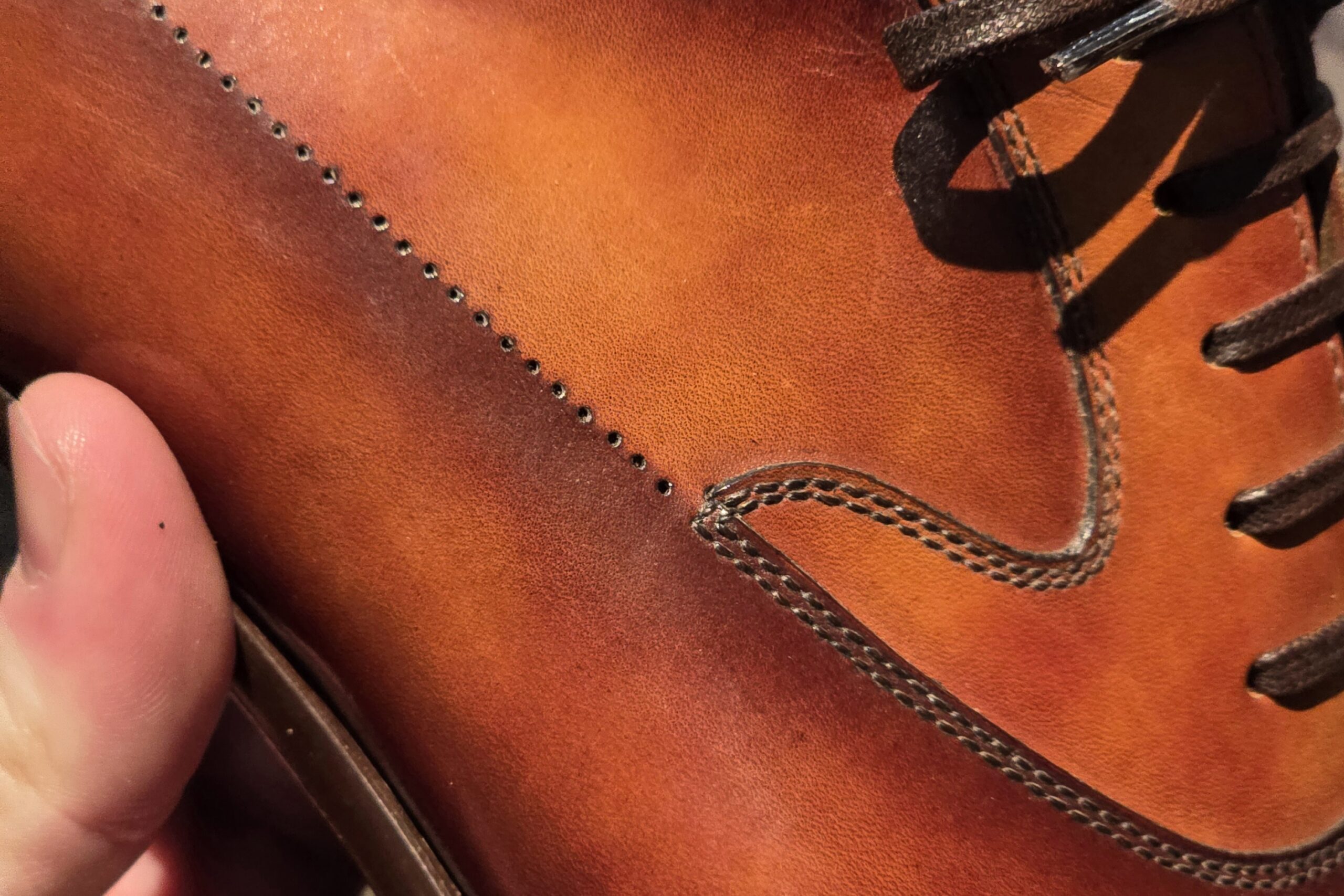
Introduction: “Leather Quality” Is Not a Simple Term
People love to say “high-quality leather,” or “Brand X uses ‘better’ leather.” But what does that really mean when discussing leather quality in dress shoes?
After more than two decades working in the dress shoe industry — handling thousands of pairs across nearly every price point — I can tell you this: Leather quality is not one single thing.
It’s a combination of:
- Hide selection
- Hide grading
- Where the leather is cut from
- Tannery standards
- Thickness and finishing
- How the factory chooses to use it
- And most importantly: Personal Preference.
Two shoes can both claim to use “full-grain leather” and still look, feel, and age completely differently. Also, the term ‘full-grain’ can be misleading. In layman’s terms, it just signifies leather that has not been corrected, sanded, etc, basically left as is. Cheap cowhide can be full-grain leather. Does that make it higher quality than a sanded calfskin?
Let’s break it down.
Hide Grading: The First Filter
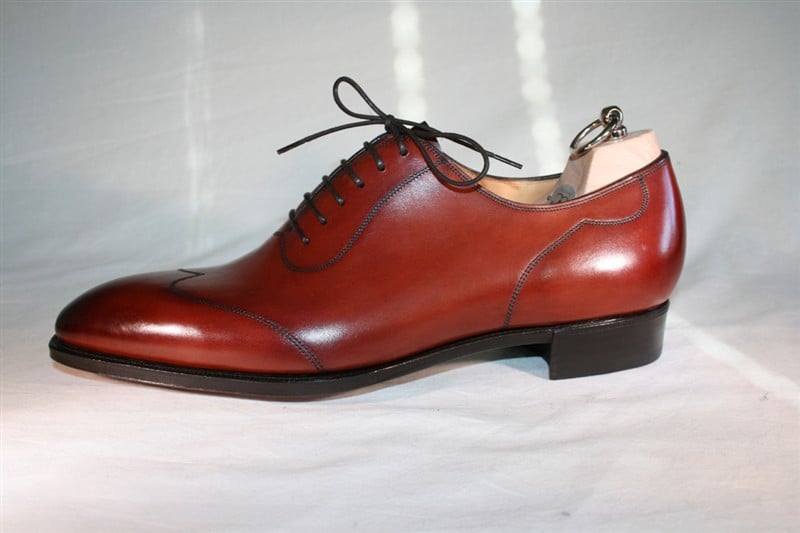
At the tannery level, hides are sorted into grades. This grading system separates hides based on visible defects, scarring, consistency of grain, and overall structural integrity.
These are often referred to as:
- Grade 1
- Grade 2
- Grade 3
Grade 1 hides typically have the fewest visible imperfections. Grade 2 and 3 hides show progressively more character marks, healed scars, or inconsistencies. So, there is no real ‘better’ leather, so to speak. There is leather that has fewer inconsistencies. No tannery only produces Grade 1 leather.
But here is where many people misunderstand the system: Even within Grade 1 hides, there are sub-levels of quality. And there is no perfect hide without any flaws. That doesn’t exist.
Not all top-grade hides are equal. Some have a tighter grain. Some have better fiber density. Some are cleaner across a larger usable surface. Others are technically top grade but closer to the threshold of becoming a second.
Two shoe manufacturers can both claim to use high-grade leather from the same tannery and still produce shoes that feel and look different. The reason is simple: one may be more selective than the other. But even more so, how leathers are used during the production process will greatly change the outcome.
One factory might cut 2 pairs from a hide. The other 4 pairs. That selectivity costs money. The one that cuts two, while technically having the same quality of leather, might be perceived as using better quality leather in their dress shoes simply for the fact that they only used the absolute best from the hide.

Where the Leather is Cut Matters
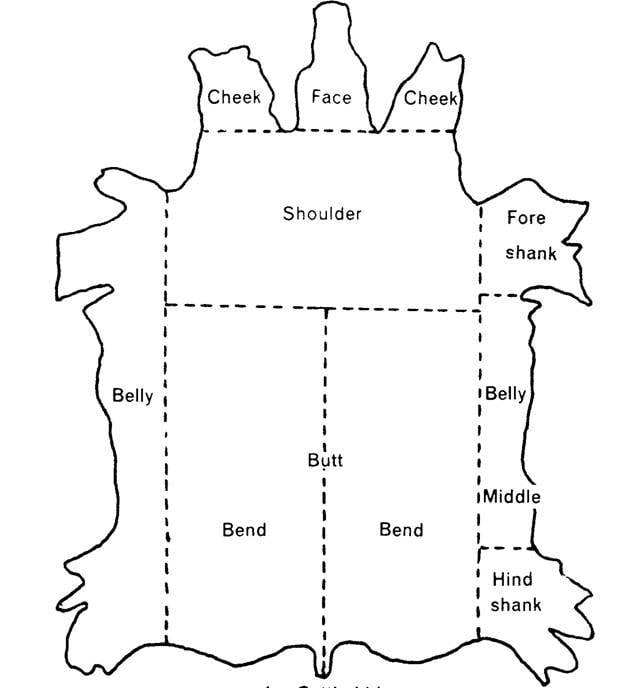
A cowhide is not uniform from edge to edge.
The most structurally stable and consistent part of the hide typically runs along the spine and central back. This area tends to have tighter grain and greater strength. It stretches less and creases more evenly.
Move toward the belly or shoulder, and you often find looser fiber structure, more visible veins, and increased elasticity. Why? Because the belly is what fluctuates if the cow gains weight, loses weight, or gets pregnant. The spinal area tends to remain constant for the most part.
When a manufacturer cuts uppers primarily from the central back, the resulting shoe often has cleaner aesthetics and more consistent long-term behavior. But cutting this way increases wastage.
If a hide could technically produce eight pairs of shoes, but only the best central sections are used, the remaining areas may be discarded or used for lower-stress components. That wastage is part of what you are paying for in higher-end footwear.
Leather quality is not just about what is used. It is moreso about what is rejected.

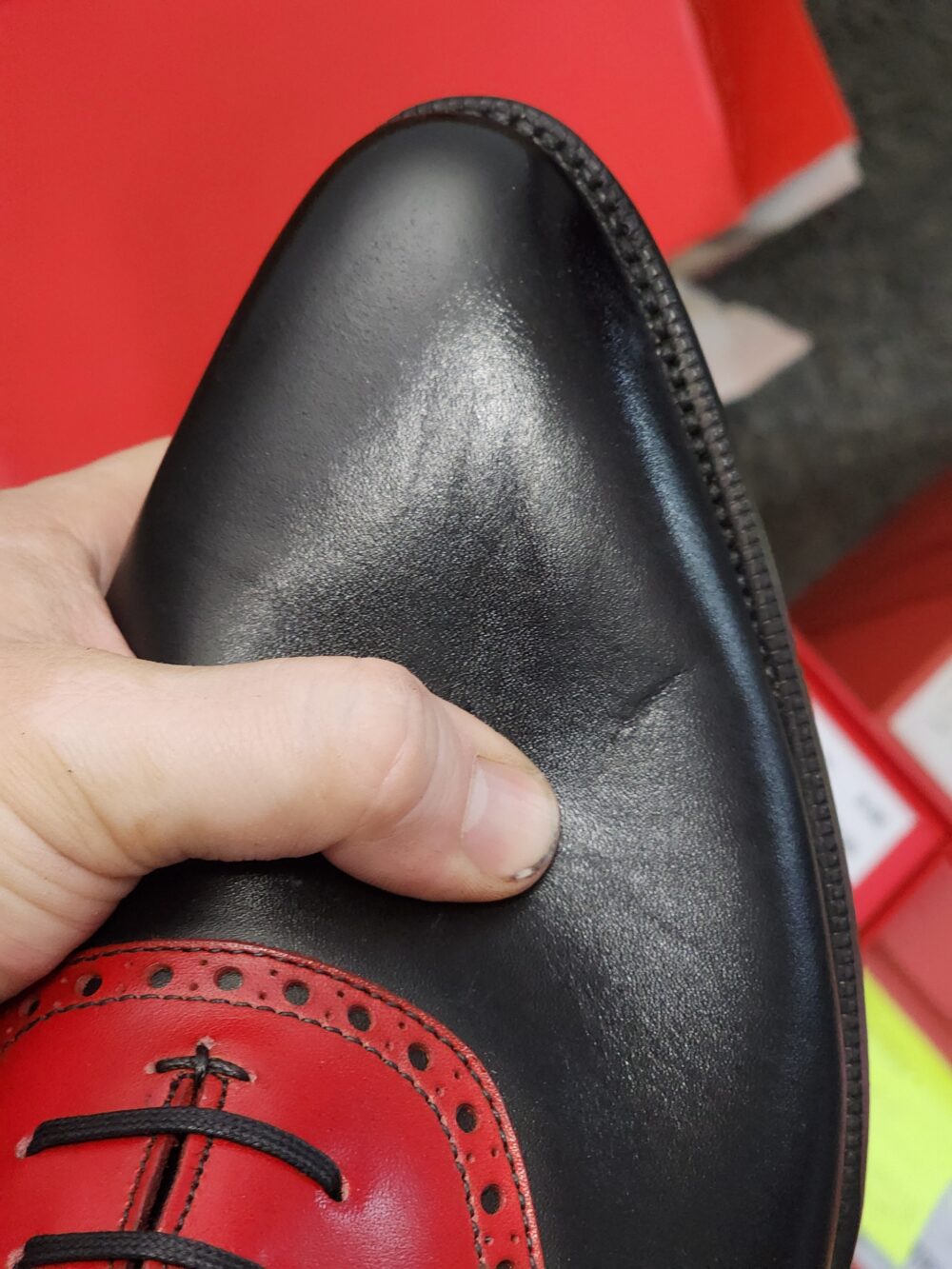
Full-Grain, Top-Grain, and the Limits of Terminology
Terms like “full-grain” and “top-grain” are often used as shorthand for quality.
Full-grain leather refers to the outermost layer of the hide that retains its natural surface. It has not been sanded or corrected to remove imperfections. Because it maintains the original fiber structure, it is generally stronger and more breathable.
Top-grain leather has had the surface lightly corrected to achieve a more uniform appearance. It can still be high quality, but it has been processed to some degree.
Corrected grain leather is more heavily sanded and often finished with pigmentation, artificial embossing, and/or some level of acrylic covering.
But terminology alone does not guarantee excellence.
Two full-grain leathers can behave completely differently depending on hide selection, tanning process, thickness, and finishing. A well-selected, properly finished full-grain leather will age differently from a lower-tier hide that technically qualifies under the same definition.
Understanding the terms is useful. But do not get caught up in them. Many subpar brands use the term ‘full-grain’ leather to try to appear high quality when in fact their shoes and leather are subpar.
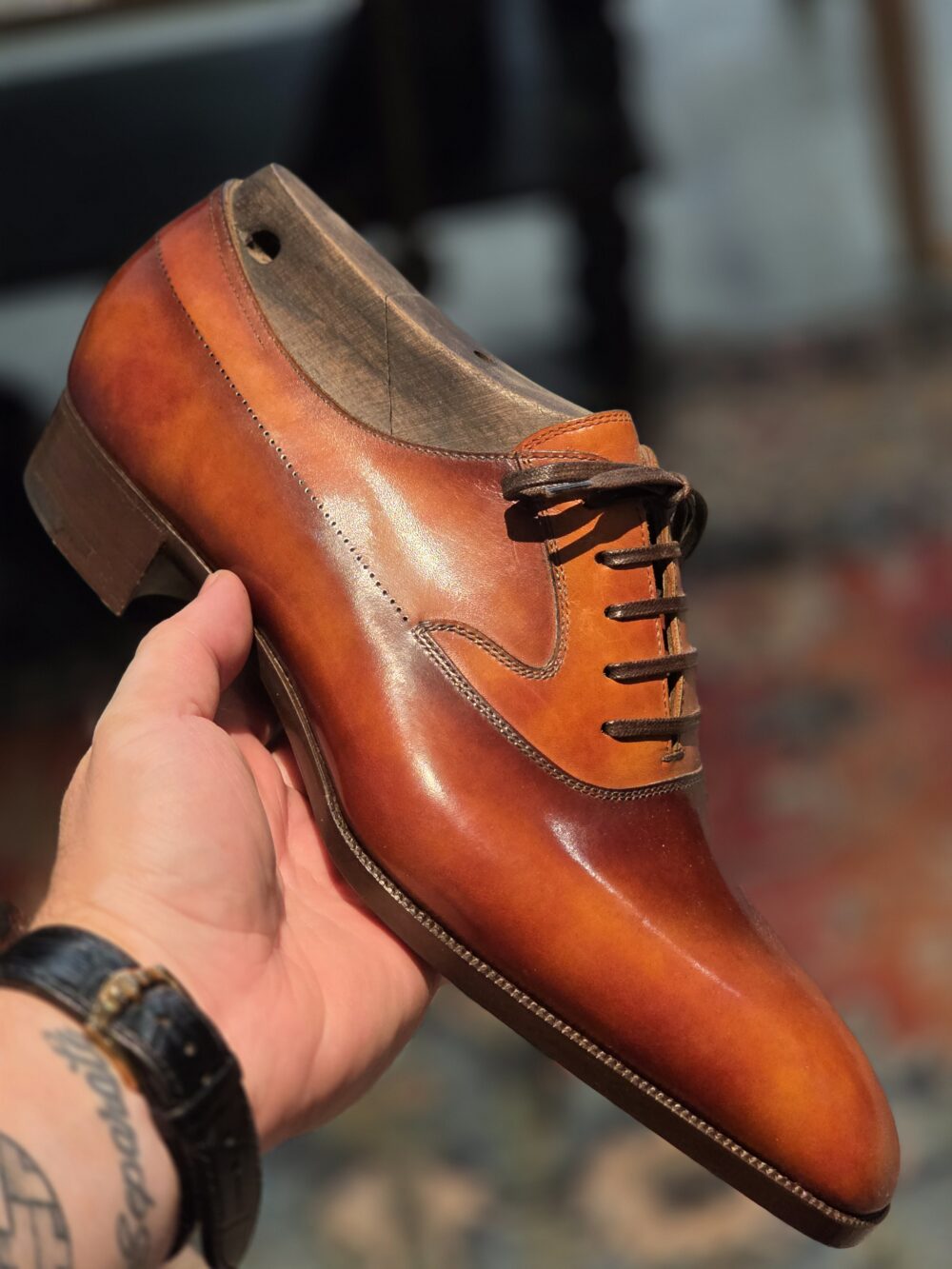
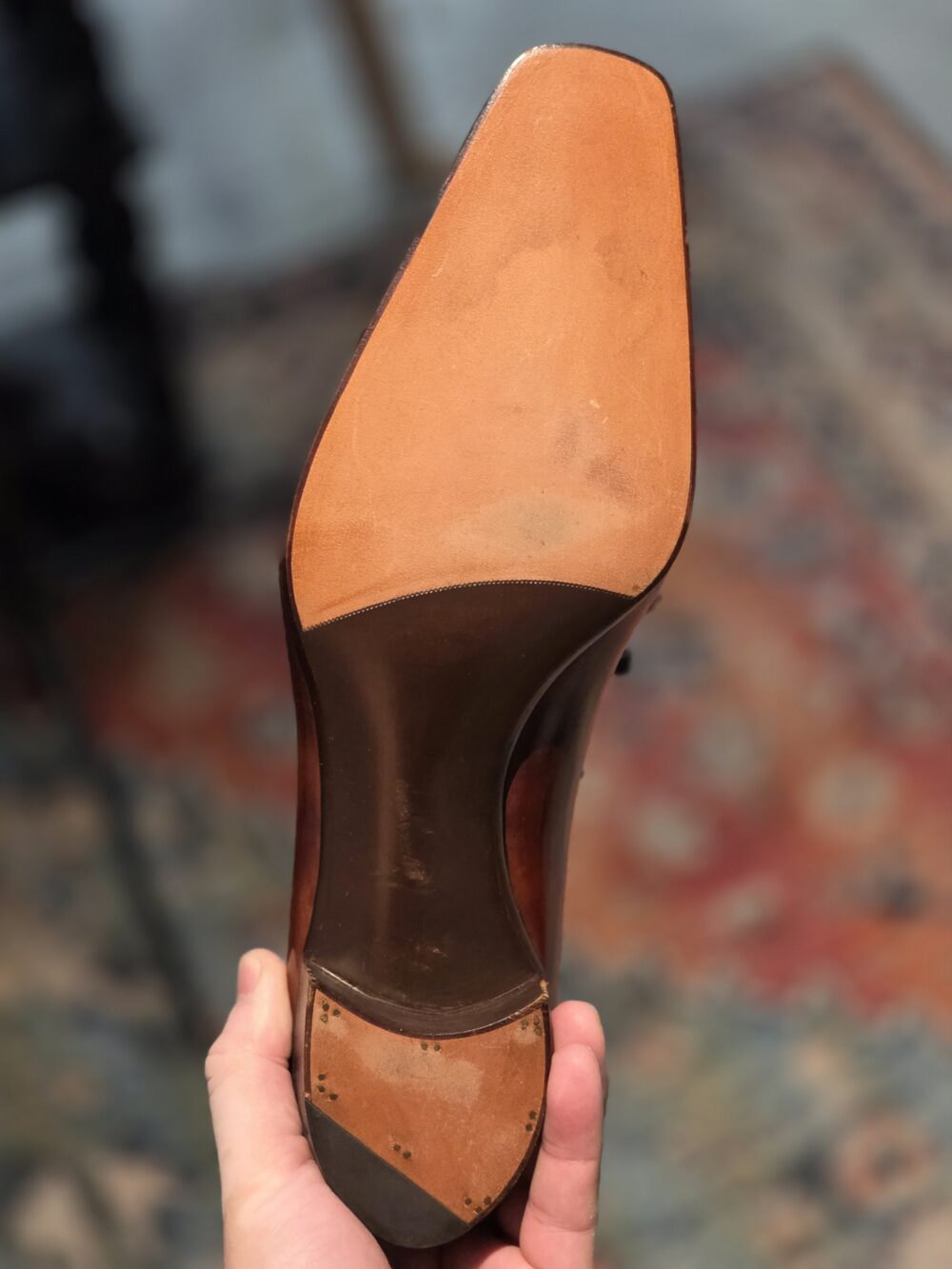
Tanneries and Finishing Matter
Not all leather is created equal, even when labeled similarly. Italian box calf often feels supple and polishes quickly. French box calf tends to have extremely tight grain but may require more effort to achieve a high shine. English suedes are often more robust and more structured than Italian suedes.
These differences are not accidental. They reflect choices in tanning chemistry, finishing methods, and drying processes. Even subtle variations in finishing can affect:
- How easily the leather shines
- How it creases
- How it responds to conditioning
- How it feels during break-in
Over years of handling different brands, you begin to recognize these differences instinctively. Leather from one source behaves predictably. Leather from another behaves differently.
Quality is partly objective. It is also partly experiential. And mostly subjective.

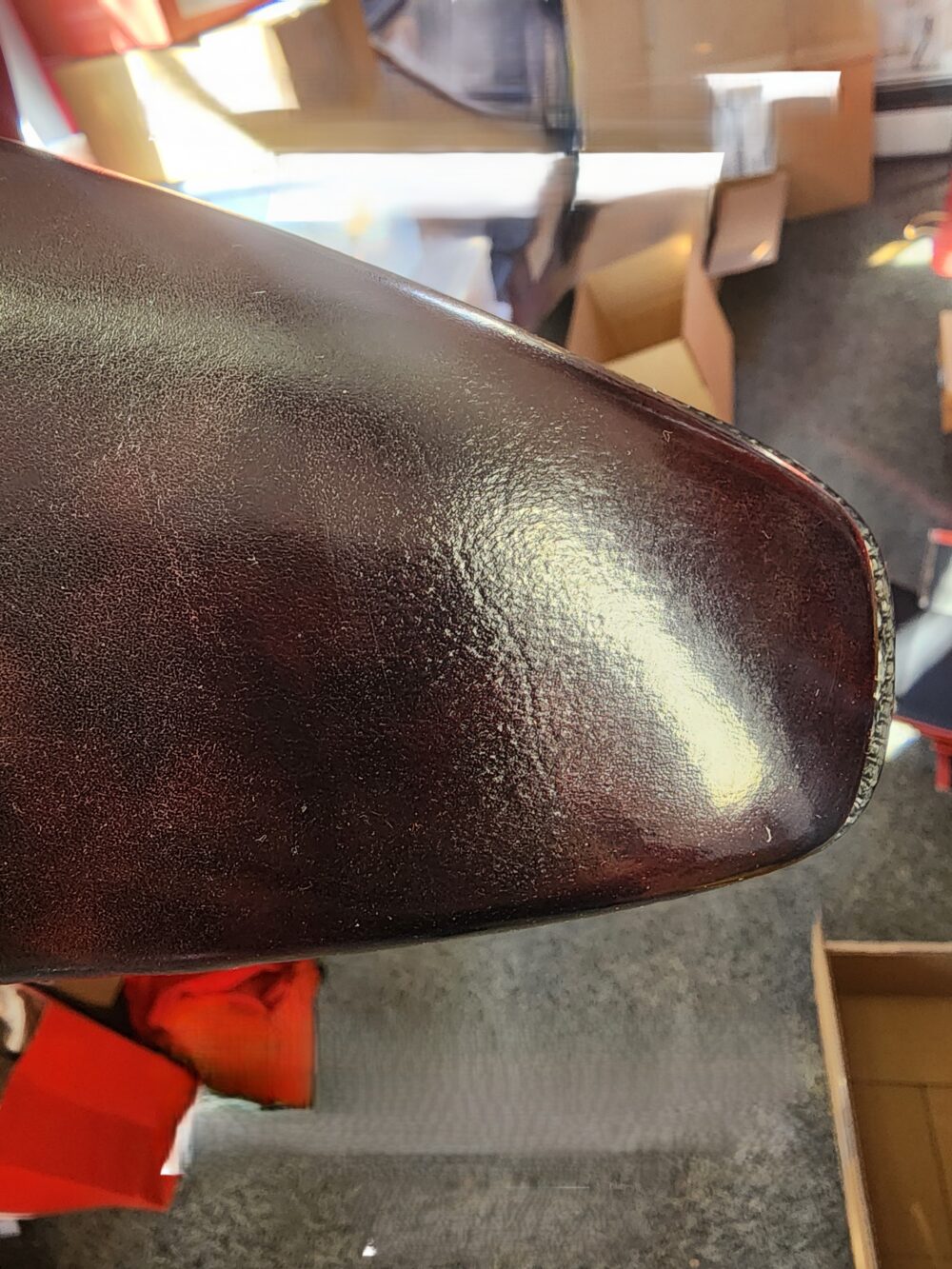
Thickness and Structure
Leather thickness is often overlooked, yet it plays a major role in how a shoe performs.
Thicker leather can feel more substantial and may crease more slowly. It may require a longer break-in, but it often maintains its structure over time. Thinner leather can feel immediately comfortable and flexible, but may show creasing more quickly.
Neither is inherently superior. The key is consistency and suitability for the design.
A structured English oxford may benefit from firmer, slightly thicker leather. A softer Italian loafer may call for something more pliable. If you start to pay attention, you will notice that Goodyear welted shoes will often use thicker, more rigid leather backed by stiffeners. Blake constructed shoes will use thinner, more pliable leather, unbacked. Is one better than the other?
Quality is about appropriateness, not uniformity.

Why Similar Shoes Can Look Different Over Time
You may see two well-made shoes at similar price points that age differently. One develops tight, fine creasing. The other shows broader folds. One builds deep patina. The other appears more uniform.
These outcomes are influenced by:
- Hide selection
- Cut placement
- Fiber density
- Finishing methods
- How well it was lasted and how long it stayed on the last
- How well the shoes fit your feet
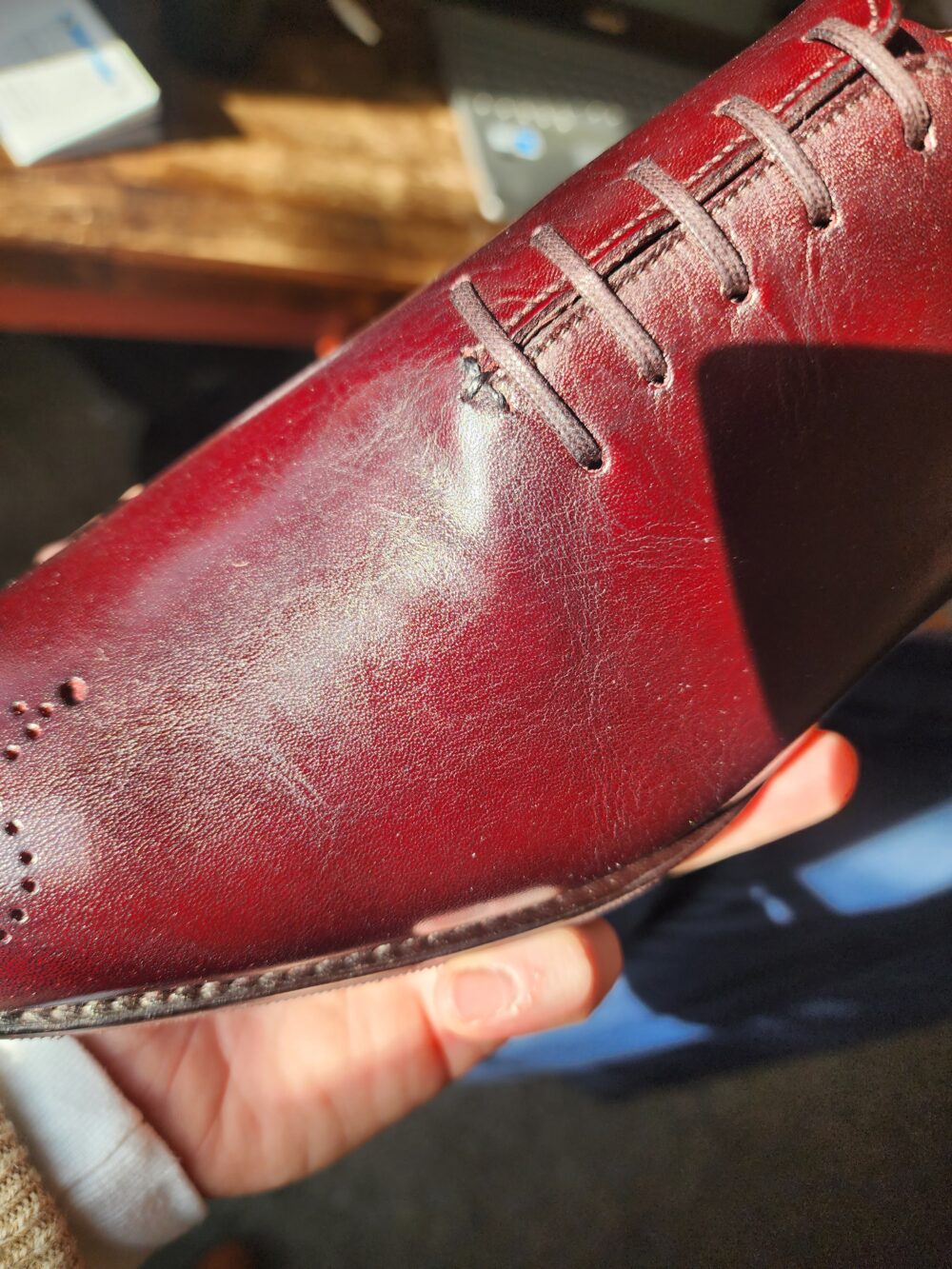
There is no exact science to how a shoe will look after wearing. You cannot really predict leather creasing and the like. Trying to always avoid imperfections will lead to a lot of disappointment.

Natural Character vs Real Defects
One of the most common misunderstandings among new buyers is the obsession over tiny marks.
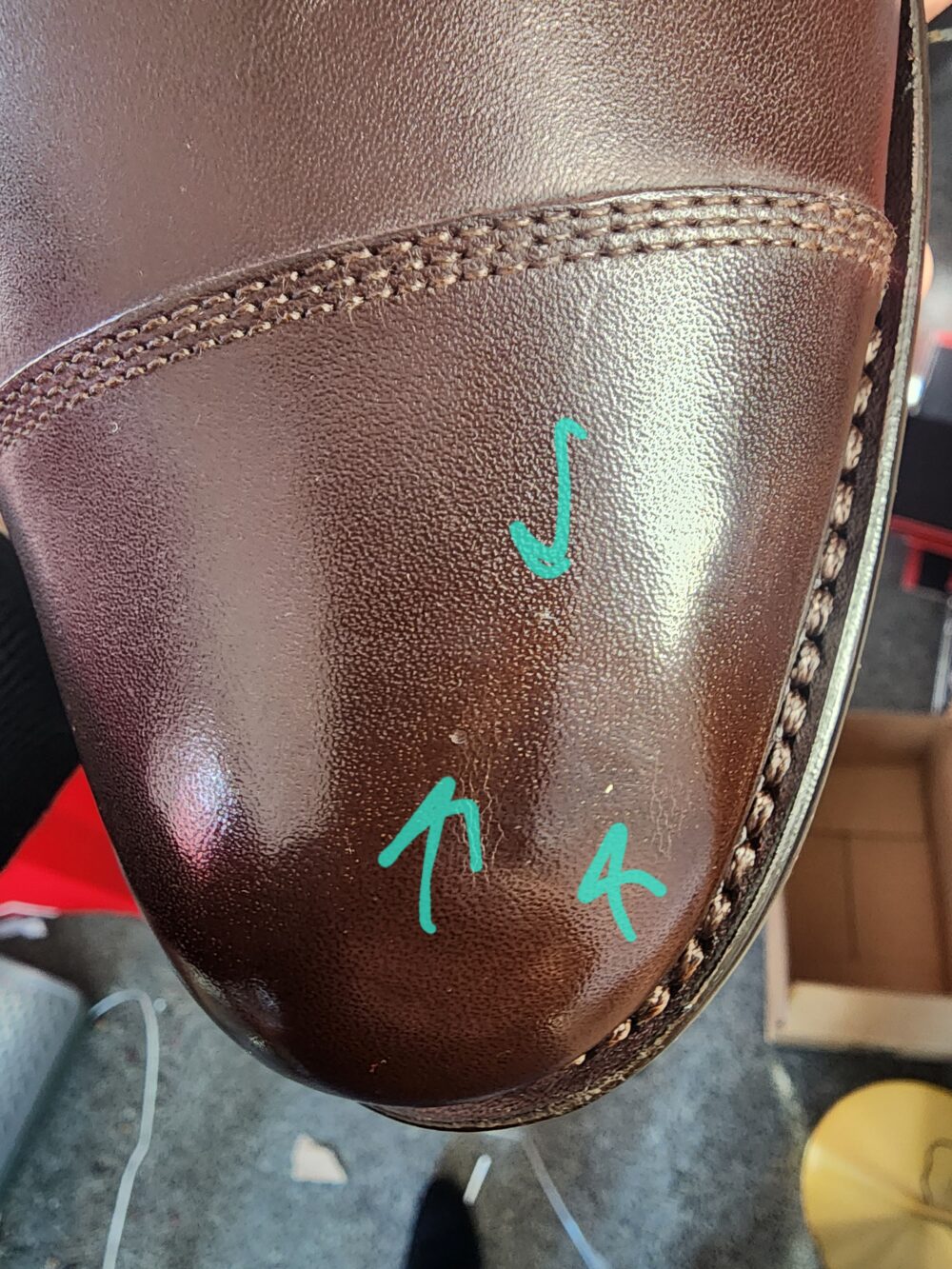
Leather is a natural material. It can show slight variation in grain pattern, subtle shade differences, or minor healed growth marks. These are not defects. They are evidence of authenticity.
A real defect is structural weakness — deep scarring that compromises integrity, excessive loose grain, or fiber breakdown. Only when it can limit the longevity of your shoes does it become a true defect. The majority of the so-called ‘flaws’ are just the characteristics of natural leather.
Learning to distinguish natural character from genuine flaws is part of becoming educated in quality footwear. And the only way to really learn this is to handle more footwear, ideally by owning, handling, and wearing it.
Perfection is often misunderstood. True quality leather ages gracefully, not flawlessly.

What Actually Matters to the Buyer
When evaluating leather quality in dress shoes, focus less on marketing language and more on observable traits:
- Look for consistency in grain.
- Look at how the leather reacts when flexed.
- Notice whether the surface feels overly coated or natural.
- Consider the reputation of the tannery and maker.
Most importantly, understand that even the best leather will crease and develop marks. The goal is not to avoid change. It is to ensure that change happens beautifully. Leather creasing is inevitable, and even the ‘best’ leathers can crease heavily.

Final Perspective
Leather quality in dress shoes is not defined by a single word or certification. Or even by a certain tannery or country of leather tanning.
It is the result of selection, cutting, tanning, finishing, and craftsmanship. It is shaped by restraint — by what the maker chooses not to use as much as what he does.
The more you understand that process, the less you will fixate on superficial perfection and the more you will appreciate how good leather evolves over time.
Because in the end, quality leather is not about remaining pristine. It is about aging well.
If you enjoy our educational posts, make sure to check the rest out here.
—Justin FitzPatrick, The Shoe Snob
Shop · Marketplace · Patreon




Keep up the great posts, always nice to learn something new about the industry. The shoe pr0n’s great too.
Regards D.
Thanks D! Appreciate that.
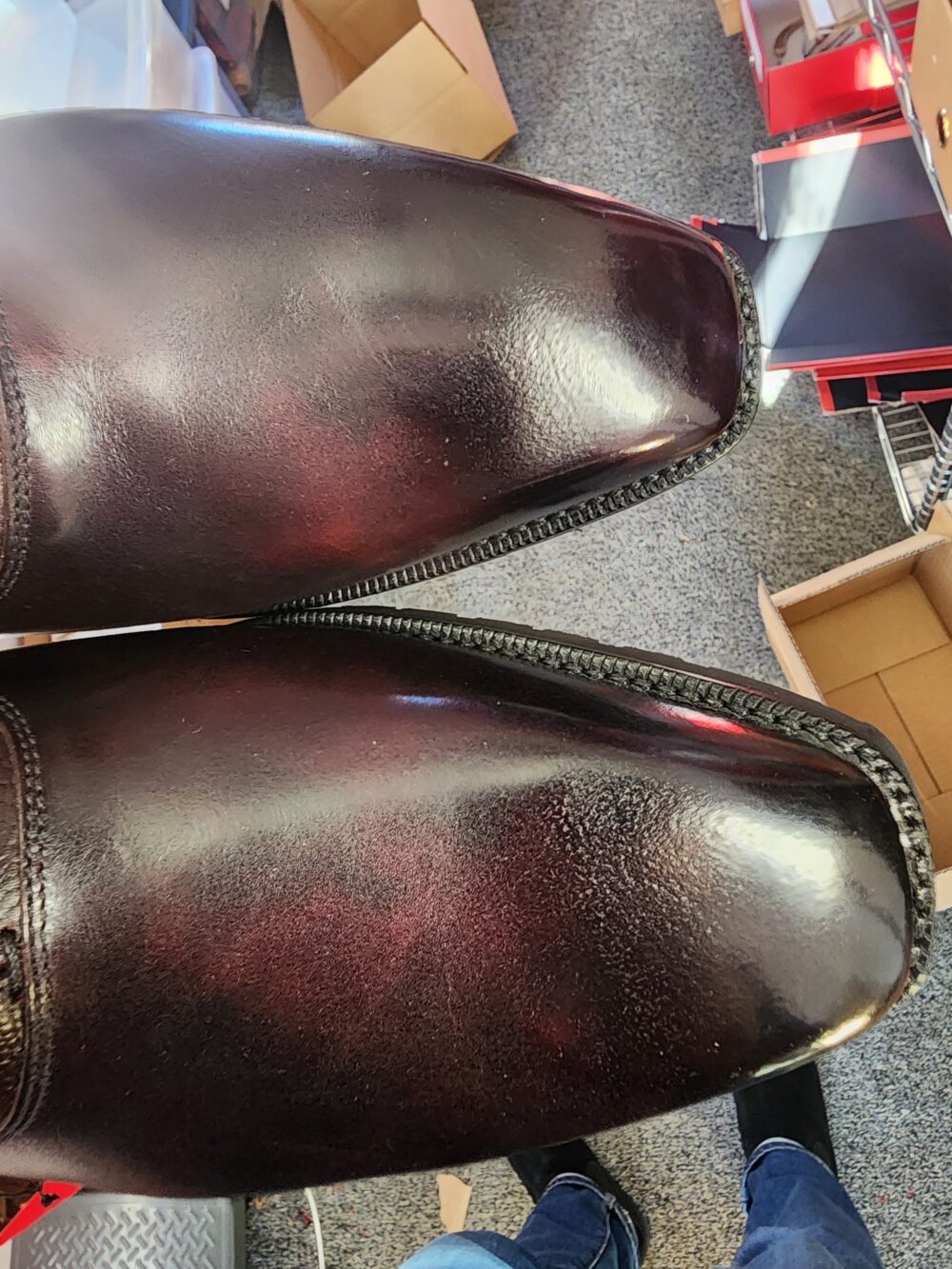
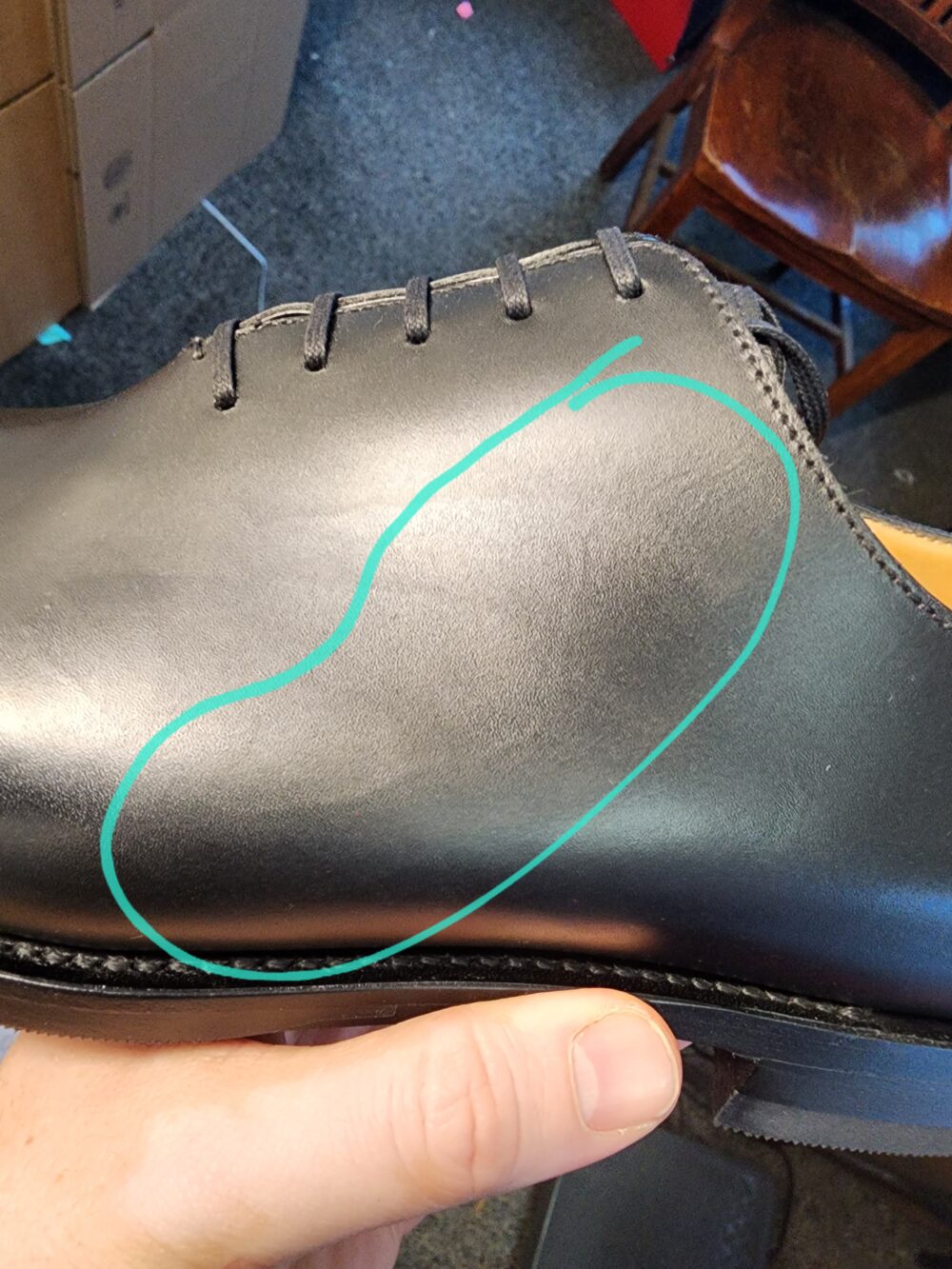
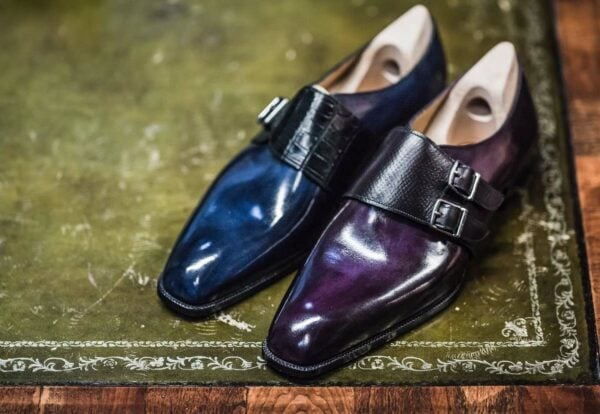
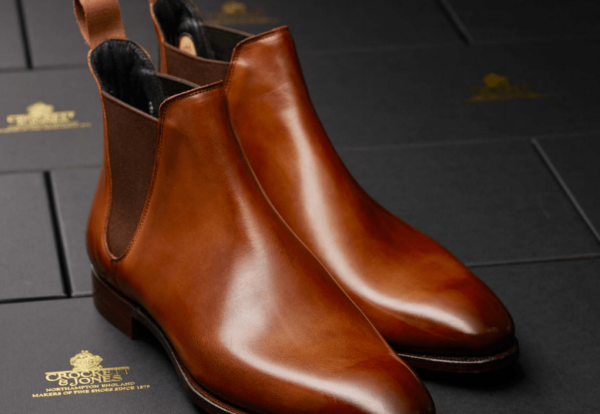
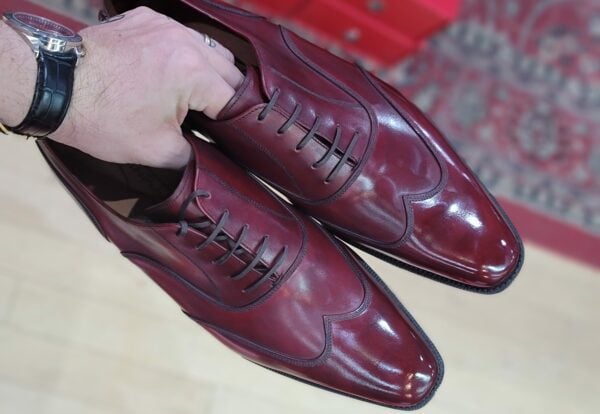
I could be wrong, but the G&G in the first pic looks bespoke given the box where the logo is printed (i.e. definitely +GBP2000)
you are correct….that is why the leather is absolutely flawless….
Great post!
thank you!
What do you think about the Saint Crispins leather? (and comparing with G&G leather). You have very instructive posts.
it is good from what i have seen & experience…a lot different than G&G but equal in quality…Saint Crispins use a much stiffer and heavier leather where as G&G’s is much softer and lighter…I prefer the soft and light to be honest….but one is not necessarily better than the other..it’s a matter of preference at this point…
Great text Justin! These things have been written about before in various ways in various places, but I’ve never read something this pedagocical and clarifying. Interesting also that french tanneries produce thinner leather that you believe crease a bit more. I’ve never thought of that, and for an amateur like me it’s always hard to tell how thin the upper leather of shoes are, expecially since manufacturers use different thickness in the lining leather, some use textile inner lining and so on.
http://www.shoegazing.se
glad that you enjoyed it! At least from what I have experienced, French calfskins always seem to be lighter and thinner with respects to their German/Polish and even Italian counterparts…And while i prefer them, I have noticed (especially with my bespoke shoes that I made while with Bemer) that they crease a whole lot more….
Have you found any strategies to decrease the creasing besides the usual shoe trees/ polishing?
-mel
Hi Justin,
Thank you so much for this clarification! We are really gratful to you! For sure, I’m not the only one to appreciate this piece of information you have provided.
It is indeed important for shoe lovers to know for instance that the quality of a very good pair of shoes start playing out at the level of the choice of leather within the top grade ones. And therefore there are top grade and top grade!
I remember a piece by Simon Crompton (Permanent Style) in which he was advising – with British shoemakers in mind – to consider shoes whose price tags start “at � 300 and something”. I then took it for granted and didn’t bother asking him how he reached this. Interestingly enough, it is the same indication you are also giving here! So below this freshold, one is, if anything, likely to witness creases on his shoes which are rather not nice, besides the longetivity issue! This is to me the first thing worth considering indeed well before going any further as to the quality of the lining, the insole, etc. etc.!
Now, the question that springs to my mind is this: has the way a shoe is taken care of any impact on how it creases? Knowing of course that its durability highly depends on how it is polished.
Thanks again for your commitment to our better appreciation of this fundamental piece of our wardrobe!
John
PS: For Fall and Winter shoes, I think the thicker leather is better even if they happen to be oxfords!
john, glad that you enjoyed the post! As per your question, well nothing can prevent creasing, but one can use shoe trees that are slightly bigger to really fill out the shoe and thus push out the creases as well as keep them from setting further into the leather…of course, regular nourishment of the leather (with stuff like the mink oil renovator) will help to make it soft and supple which also helps in making sure the creasing does not stay prominent…. hope that this helps and thanks for your appreciation of my work, that means a lot!
Hi Justin,
Thanks for this advice.
You are really doing a good job, not just for us your readers, but also for the shoe industry itself. Look, less ignorance is better for them too. Frankly, how could one otherwise understand why a pair of G&G or EG is so expensive?
Presumably, in the long run there will be a pre-and-post-ShoeSnob readership signaling a broad devide between those who can confidently set their sight on a pair of shoes, and knowingly buy it as a wise investment.
Thanks for the kind words my friend, glad to know that you are enjoying the read!
Thanks for the very informative post, & esp. for the photo clarifications of the points you’re making.
Nick D.
my pleasure Nick!
very interesting! I think this helps explain the otherwise faultless ‘seconds’ people pick up from the northampton factories and the london shops during the sales, Ive just gone to a pair of cleverley that i picked up in the christmas sale and the leather in less noticeable areas isnt a good looking when viewed next to a pair brought at full price
you are dead on with that statement….
That was an exceedingly informative post – I learned a lot.
Glad to hear it Roger!
For your shoe line, what portion of the hide do you use?
For someone who doesn’t handle shoes everyday, how can we really have an idea of the quality of the $450+ shoe we are considering?
In other words, can we as customers really tell the difference between a Alfred Sargent shoe and an Edward Green shoe? If so, how can we judge whether the additional cost is truly worth it?
that’s a good question to be honest. I don’t control every step of my production, only the final product, so I can’t say with certainty. From what I have seen, i would say anywhere from lower end grade 1 down to grade variants of grade 2….if they use a grade three and it looks bad, I simply reject the model and send it back…. As far as what portion of the hide, I am sure that my factory uses all of it…we are not G&G or JL and my prices show that…
For a person that doesn’t handle shoes everyday, well you just have to use your eyes and the best common sense possible…but from what I have started learning about shoes, consumers cannot expert the highest levels of leather on all shoes above $450. One cannot expect C&J to have the same as G&G, nor even more ridiculous, is the belief that Meermin at those prices should have the same consistency as JL or the likes. The price of leather is continuously rising, especially as these big stupid conglomerates keep buying up tanneries….I actually fear what it will be like in 5-10 years…. But as a consumer, well price should tell you that there is a difference in leather as it is the main component of cost…
Great post, Justin!
thank you!
This is a great post indeed! Now, we know you are enthusiastic about – among many middle range shoes – those of the French Septi�me Largeur. But what about the quality of the leather this shoemaker use?
This post and the ensuing comments have completely changed my personal approach to shoes. From now on, before buying a new pair of shoes, I will adamantly stick to 1. the quality of the upper leathers, 2. the construction (Blake vs Goodyear, and quality), and finaly the style. In that order.
But then, not being in the know, I wonder whom I should then rely on. Unfortunately, more often than not the sellers do not know either…
It’s hard to say my friend…they probably use a mixture between grade one and two and possibly even three…I don’t work in the factory, so I can’t really say for sure what they are using…the eye should tell you though….but at their prices one cannot expect to only get grade 1 leather, that is not practical…. Glad that you enjoyed the post!
If I may briefly venture a bit downmarket from the likes of G&G, can I ask. Question about Allen Edmonds here?
I was told the other day that Allen Edmonds use a higher quality leather for their own shoes than for the visually identical shoes they make for Brooks Brothers.
Is this likely?
Laurence
like I told the guy above, I can’t say really. It takes one working in a factory or tanner to know these answers. A lot of what i got in this post, was from an owner of a factory that only uses grade 1 on their shoes. I suspect that Allen Edmonds is using anywhere from lower end grade 1 down to grade three, but this is just common sense speculation, no proof in it… I am not sure if that other statement is true as Brooks brothers would notice it and reject the stock, which would create a lot of waste for Allen Edmonds…
great read thanks Justin
My pleasure!
Great post Justin! Now I just need the same simple clarification for alligator and crocodile skins used to make shoes.
Thanks,
Leo
for croc/alligator, a good maker should only get one pair out of a skin….
I am planning to make my own leather dress shoes but I would like to know where could I obtain the best quality leather. What should I use? I never made my own leather dress shoes before. If you can kindly tell me I would greatly appreciate it!
you should use calfskin and you can get some at http://www.aacrack.co.uk/catalogue.asp?page=home
its hard my friend, unless you really know leather…plus just because you pick something doesn’t mean that he will only use the best pieces of the leather too…he could very well use the belly..best to ask where his leather is from, what tanneries etc…good leather comes from France, some Italian, some German/Polish, Suedes from England etc…best of luck
you should read a book called Handmade Shoes by Laszlo Vass…you will not gain the skills from this website…no untreated leather is really water resistant…
Hi, I would like to know how much leather is need it to manufacture a shoes? (Approximately) Thanks
depends on how much of the leather you are using (quality wise)…for 1 square meter, you can get about maximum of 5 pairs.
I have just discovered this blog a few weeks ago so forgive the comment on an old post.
A very insightful and enlightening post. One point troubles me though (and would be grateful if you could clarify), I have been told numerous times (including by those in the industry, I think at one point it was even mentioned in a video by a Crocketts employee) that C & J, Trickets etc use the same grade leather as Lobb & Edward Green and that the main difference is that the latter use the hide far more selectively (Lobb gets a single pair out of each hide, C&J gets 2-3). This obviously leads to a difference in quality, and I may have misread your article, but you seem to suggest that there is a much larger difference. From how it was explained to me, I was also under the impression that construction, shape and labour played a much greater role in price (at least at a C&J vs Lobb or EG pricepoint) than the quality of the leather. I tend to believe this as looking at leathers which can only be bought at one quality (like Shell Cordovan, which is graded by size and not quality) the price gap remains unchanged.
For the most part you are correct. But when you buy leather from a tannery, you have to buy an assortment of grades 1-3. They will not sell you just grade 1. They will sell you just grade 3 if you want but if they only sold grade 1 to people some massive brands would buy it all up and create monopolies so there are rules put into place. Yes, it is rumored that Lobb will cut one shoe from a piece of leather but I am sure that they will do so from grades 1-3. The grades simply denote the amount of imperfections on a hide that is about 1.5-2 meters squared….you can cut one perfect shoe on a grade 3 hide. But not more than one. So yes, you are correct as we are mainly all using the same quality of leather (those from +£300). What separates the pricing is the amount of wastage one is creating. But there are tricks to shoemaking too that can make leather look nicer. The better a shoe is lasted, the better the leather will look. Loose leather looks bad, tight leather looks good. And there are many other factors too…finishing is a great part of expensive shoes.
This entire blog post and thread of comments has been so insightful, but this comment is so on point. Eye-opening, to say the least. It’s all starting to make a lot more sense, in terms of price points and what cause them. Appreciate you and everyone participating here! Four years later, the info is just as relevant!
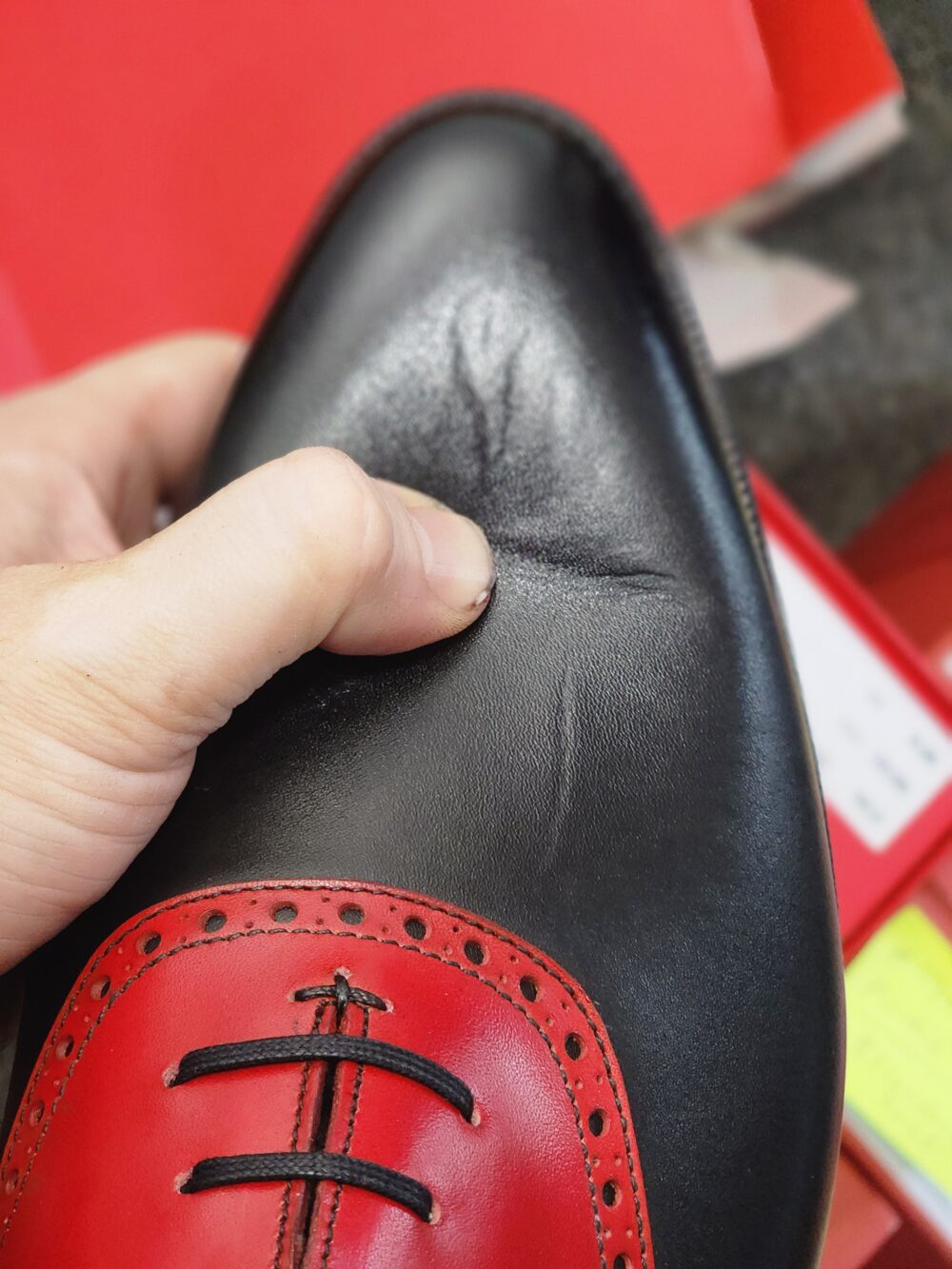
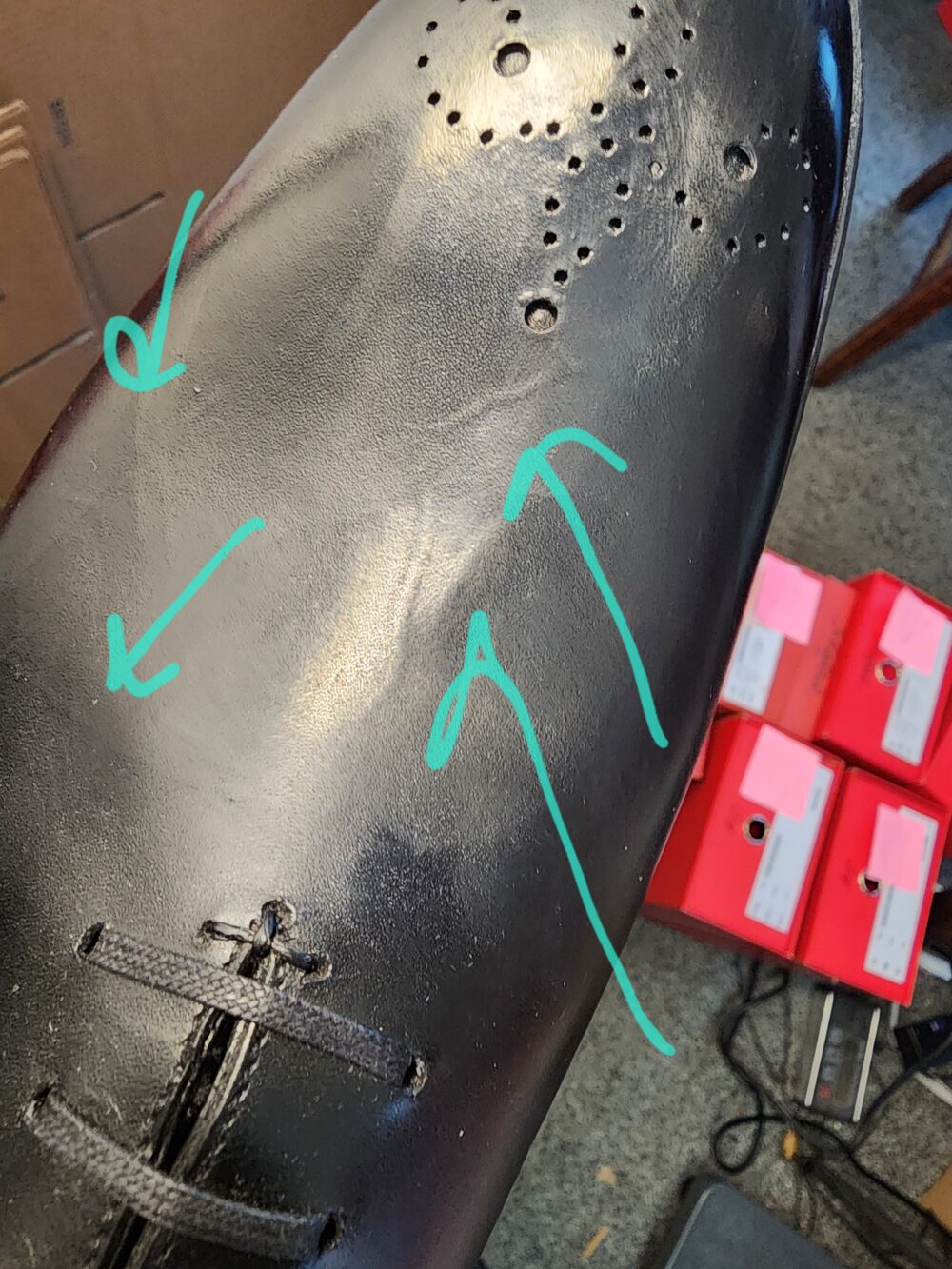
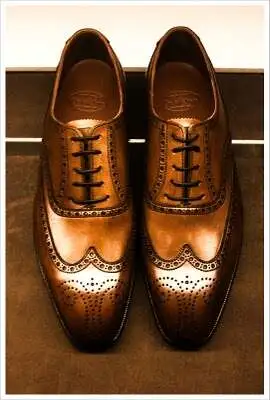
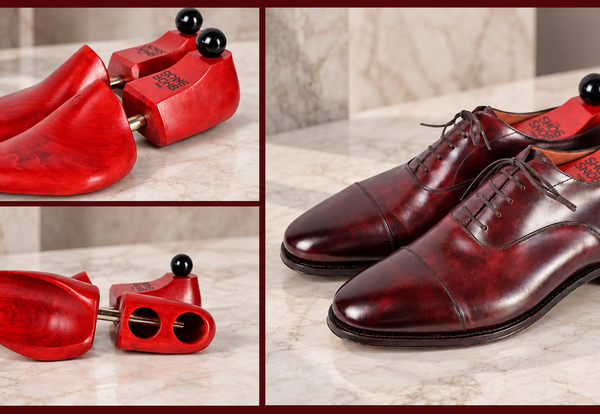
What kind of leather is the one used on shoes Image #4 ?? It’s not as shiny as the others, it is not intended to do so . How do you take care of it?
that is regular french calfskin. It is not shiny as they did not put any polish on it in the finishing stage. You would care for it just like any other leather
C&J is better IMHO, go that route
Isn’t the “C&J” actually a Ludwig Reiter?
no pretty sure it’s the waymouth — http://www.crockettandjones.com/product/weymouth-darkbrown
Hi Justin. These days leather seems to range from calf to camel. Apart from their texture (aesthetic) is there a stark difference as to where e.g. quality, break in period, how it ages is concerned? Is this also same where different suedes are concerned? I ask as i am confused while trying to pick between leather for my shoes. Thanks!
yes, it all varies and unfortunately I am not really able to explain it all here. Maybe I can make a post of it soon
HI there. I bought me a pair of ankle leather boots. The two somehow differs slighty in colour and shine. Is that normal ??
that very much depends on where you bought them, the price you paid and the quality of the manufacturer. I need more facts before i can answer in a concrete manner
I have a pair of ancient Florsheim plain Cordovan and wingtip Cordovans.
I have used black sole edging on them – is this wrong. I forget what color the original soles were.
Also, I have been insisting on leather heels. when they are replaced I get a leather heel with a triangle inset of metal to deter wear.
The metal triangles make a click on stone and cement – does this make me look bad?
I put metal toe caps on the front end of the sole on all my shoes but never heard of metal heels. I can imagine they can be quite damaging to wooden flooring.
Very interesting post on understanding degrees of leather quality.
What confuses me most about comparing leather quality across brands is the proprietary element from some luxury brands. Examples that come to mind: Berluti’s Venezia, LV’s Epi and anything from Hermes. Clever marketing for sure but it’s hard to evaluate the quality since they have such distinct qualities.
https://uploads.disquscdn.com/images/4f1b9a5eb44b8510c5f5ff9cd29d697867db776e3f66fa6aafd7a77f68ef4055.jpg I recently bought a pair of men’s shoes (used) and I cannot find any info on the brand. is there anyway that you can help?
I always (mistakenly) believed that higher quality leather would crease less or not at all as compared to low quality leather, but this post has helpfully dispelled those incorrect notions. In that case, apart from your brief comment that higher quality leather feels softer, nicer. smoother and is more taut, what other features distinguish great quality leather from poor quality leather (assuming that full grain leather is used)?
I ask this because from my reading on SF, there appears to be a general consensus that some brands (e.g. G&G) use much higher quality leather than others (e.g. Loake). Practically speaking, what are the differences between the qualities of leathers used between these brands, and would it be possible for a trained eye to discern quality of leather from a glance?
Thank you so much for your post!
“Leather makers” lol. Is that next to the factory that makes eggs?
Next to the factory that makes the chickens, actually
Outstanding education about leather quality. I learned a lot. Thanks for shoring.
Thanks Michael!
Say more about cow stress now vs in the past
Yes, that is a great topic to discuss but my knowledge is only speculation. I must speak to an actual tannery to get this info. I shall look into it