
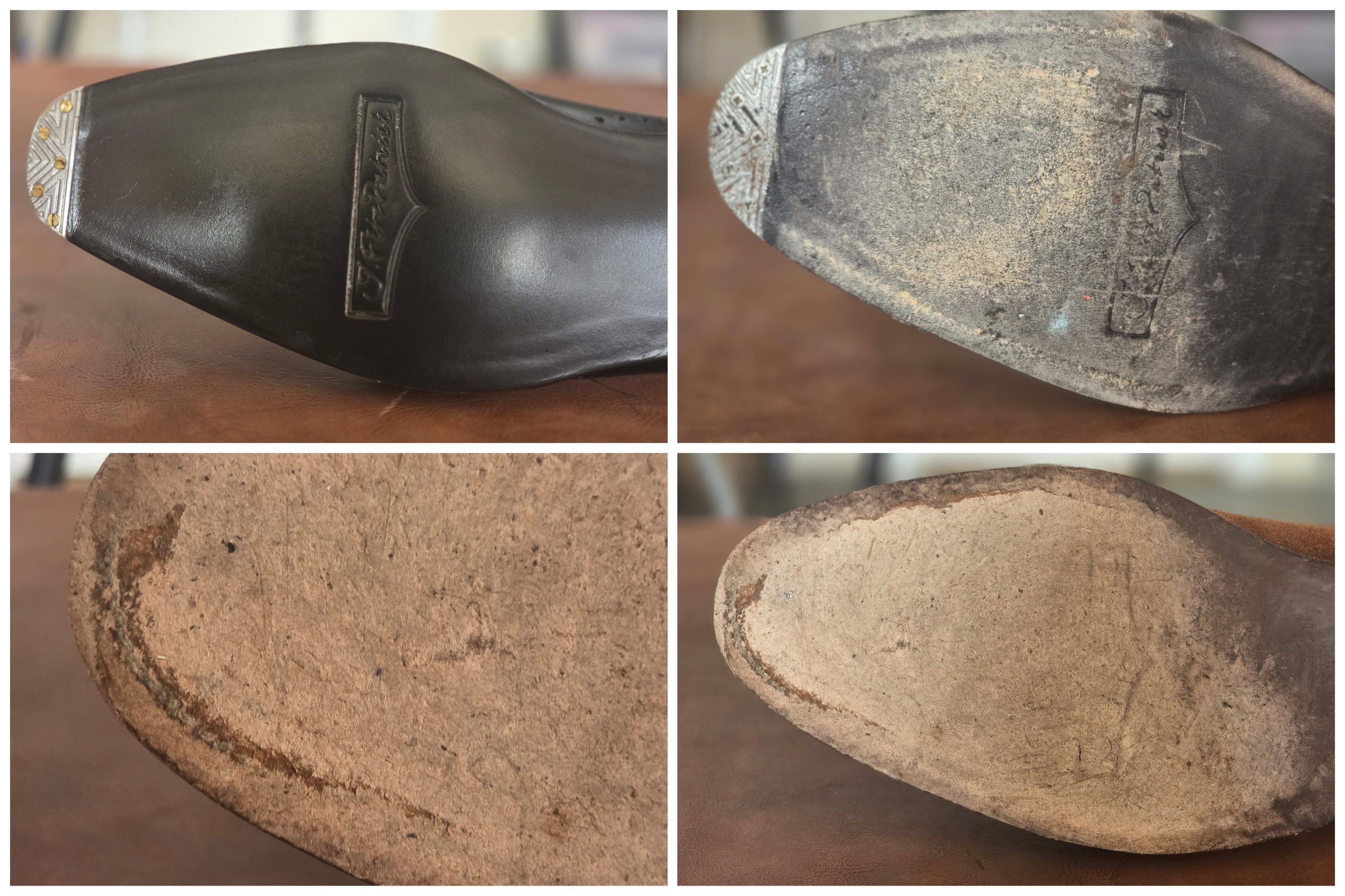
In my over 20 years of dealing with fine footwear, and particularly throughout my quest to create some of the best-value welted shoes on the market, I have often found myself in a bit of an internal struggle over one particular detail: the closed-channel leather sole.
On one hand, there is no denying the beauty of a perfectly finished closed-channel sole. It creates a clean, elegant appearance that many of us associate with the highest levels of shoemaking. On the other hand, there is an inherent weakness in this finishing technique that can sometimes create more headaches than the beauty is worth.
And that is when the thin leather flap covering the channel stitching comes loose, breaks away, or wears down, leaving what appears to be a damaged sole.
For someone unfamiliar with this type of construction, it can be quite alarming. I’ve had countless customers over the years contact me concerned that their shoes are falling apart, sometimes after only a handful of wears.
But here’s the reality: exposed channel stitching does not automatically mean that your leather sole is damaged, defective, or nearing the end of its life. More often than not, it’s simply a natural part of wearing leather-soled shoes.
What Is a Closed-Channel Leather Sole?
To understand why this happens, you first need to understand the difference between open-channel and closed-channel stitching.
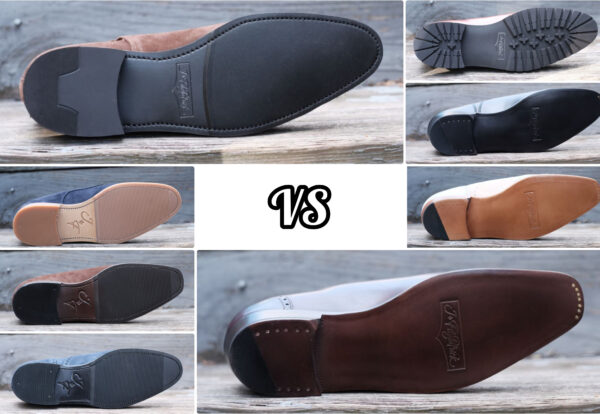
On a traditional Goodyear-welted shoe, the outsole is stitched to the welt. With an open-channel sole, this stitching is visible on the bottom of the shoe. There is no leather covering hiding it, and the stitching is exposed from the very beginning.
A closed-channel sole takes this process a step further.
Before attaching the outsole, the shoemaker cuts a thin flap into the bottom of the sole leather. This flap is lifted, allowing the outsole to be stitched to the welt underneath. Once the stitching is complete, the flap is glued back down, concealing the stitches and creating that beautiful, uninterrupted leather finish.
That’s it. The underlying construction is essentially the same. The difference is primarily one of finishing.
Naturally, creating a closed channel involves additional steps, additional labor, and additional expense. This is why you will generally see open-channel soles on more entry-level welted footwear, while closed-channel finishing tends to become more common as you move into the higher echelons of the industry.
But that extra work doesn’t necessarily make the shoe stronger or increase its lifespan. It simply makes the sole more beautiful when new.
I’ve explained this in greater detail in my article on Closed vs. Open Channel Sole Stitching.
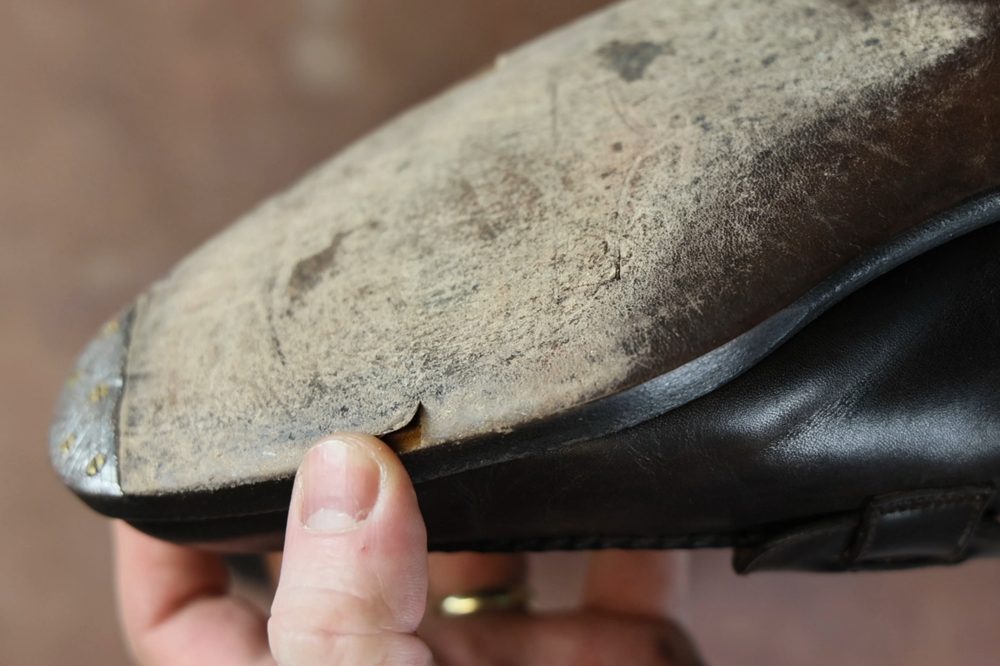
Why Closed-Channel Leather Soles Can Peel or Break
The downside to all of this extra craftsmanship is that the covering itself is nothing more than a very thin piece of leather held down by adhesive. And leather, particularly when it’s thin, is not indestructible.
There are also varying techniques used to finish the edges of closed-channel soles. Some makers leave the covering very close to the outer edge of the sole, while others finish it further inward or more flush with the surrounding leather.
Depending on how the channel has been cut and finished, a small exposed edge can create an easy target for something to catch. And when I say something, I’m talking about the everyday surfaces that we walk on.
Concrete is not perfectly smooth. Neither is asphalt. There are countless little rocks, cracks, ridges, and rough surfaces that can catch the edge of that thin leather flap and pull it away from the sole.
Now add moisture to the equation.
Leather absorbs water, which temporarily softens it and makes it more susceptible to abrasion and damage. Moisture can also weaken the adhesive holding the channel covering down. When those two things come together, you have the perfect scenario for a flap to start lifting, tearing, or breaking away.
This is particularly common when brand-new leather soles are worn in wet conditions before they’ve had a chance to wear in naturally.
It’s one reason I always recommend breaking in new leather-soled shoes on dry days initially. As the sole begins to wear, those delicate edges gradually become smoother and less likely to catch on something.
It’s equally important to allow your shoes to dry properly between wears, particularly after they’ve been exposed to rain. Wearing them again while the leather is still damp only increases their vulnerability.
And unfortunately, even if you do everything right, you can still catch a sharp rock at the wrong angle and tear a section of the channel away. That’s simply the nature of the construction.
Exposed Sole Stitching Does Not Mean Your Shoes Are Falling Apart
This is where I think many people misunderstand what they’re looking at. When that leather flap lifts or breaks away, the stitching underneath becomes visible. To someone who has never experienced this before, it can appear as though part of the sole has been ripped open.
But that stitching was always there. In fact, if you were wearing an open-channel shoe, you would have been looking at that exact same stitching from the day you purchased it.
The fact that a covering has disappeared doesn’t suddenly mean the construction has been compromised.
I’ve seen this happen on shoes from some of the finest makers in the world, including Gaziano & Girling. I dealt with it throughout the years of running my own footwear brand, and I’ve experienced it on numerous pairs from my personal collection.
There is no magical price point at which this stops happening. You can spend $300 on a pair of Goodyear-welted shoes or $2,000 on a pair of English-made oxfords, and a sharp piece of gravel isn’t going to care how much you paid.
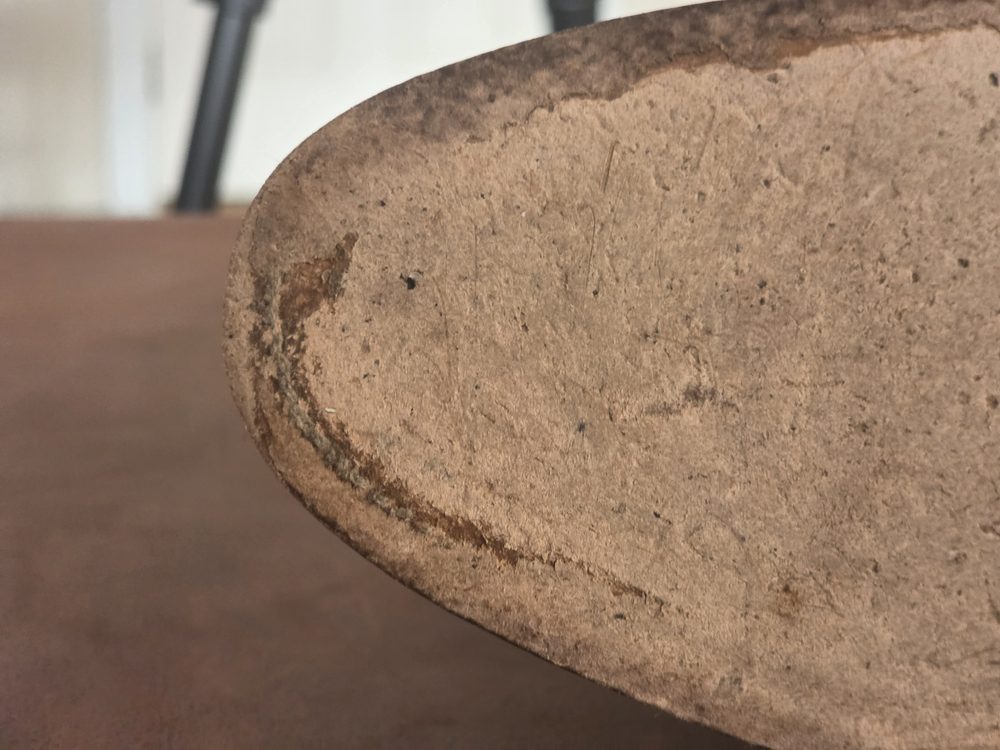
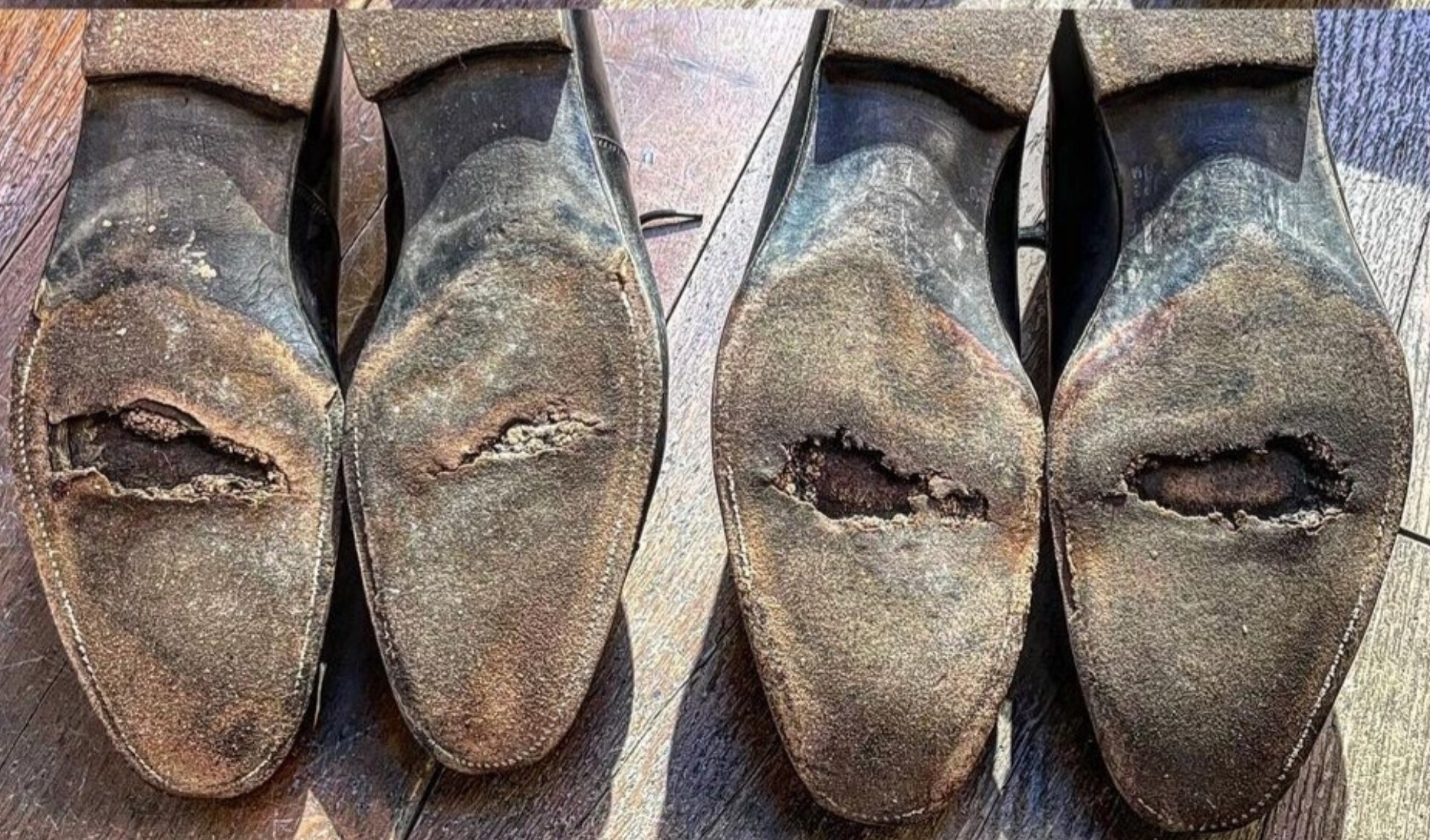
Take a look at the Edward Green shoes featured in the photographs here, courtesy of Leffot.
Edward Green is renowned for its beautiful closed-channel leather soles, yet these particular shoes have been worn to the point where much of the original covering has disappeared, and the stitching is clearly exposed.
That is simply what happens to leather soles as they are repeatedly worn on abrasive surfaces. And notice something else in those photographs.
The exposed stitching isn’t necessarily the biggest concern. It’s the worn-down leather in the center of the forefoot, particularly where a hole has developed, that you really need to pay attention to.
There’s a significant difference between a cosmetic covering coming loose and the actual outsole wearing through.
How to Fix a Damaged Closed-Channel Leather Sole
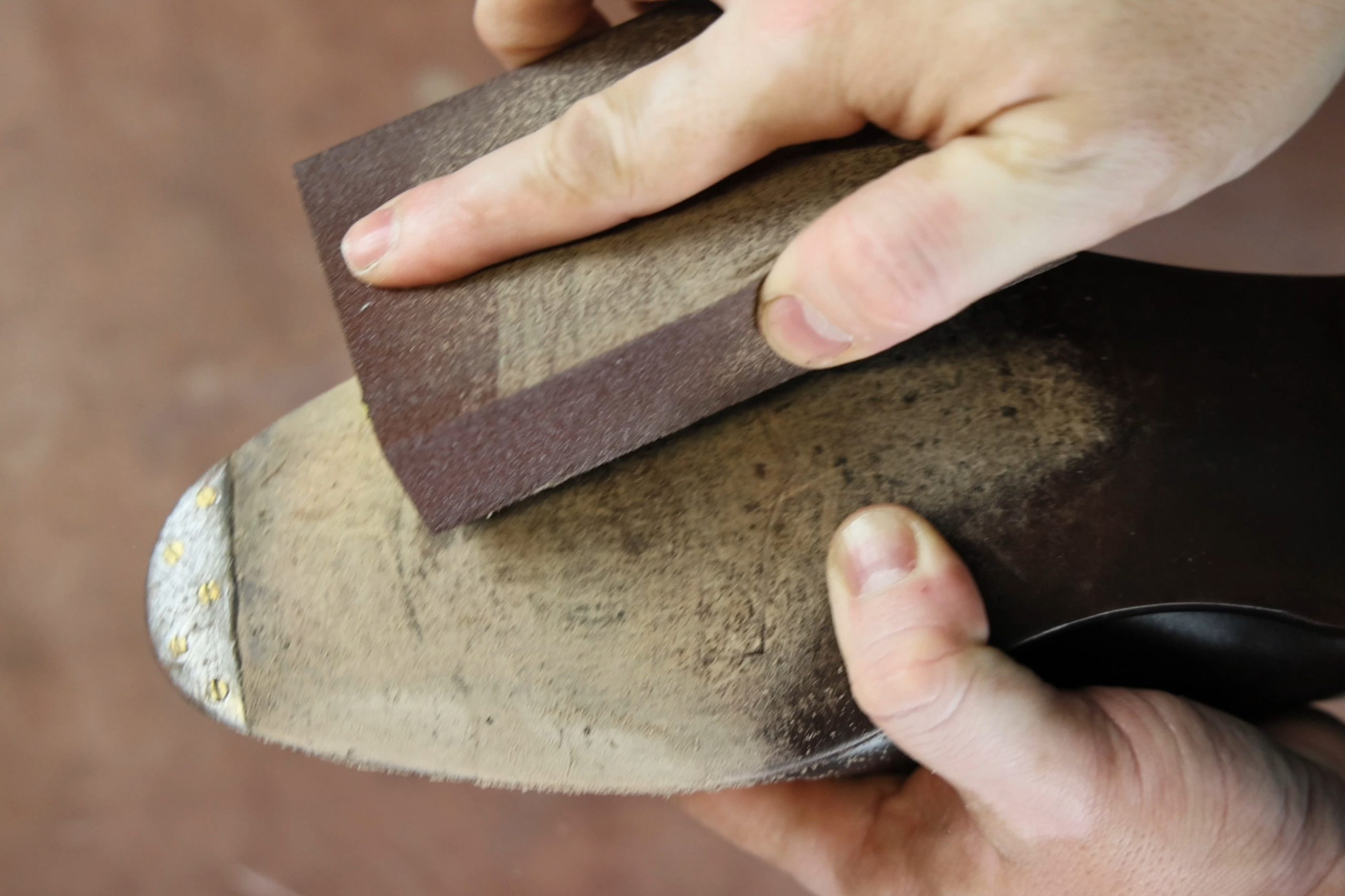
Fortunately, if your issue is simply a small section of the channel covering lifting or tearing away, the solution can often be relatively straightforward. I’ve actually demonstrated this exact scenario on a pair of my own shoes in my video tutorial, How to Repair a Damaged Closed-Channel Leather Sole.
In that example, a section of the thin leather covering had caught on something and torn away, leaving an unsightly area on the bottom of the shoe. Rather than panic, I simply tidied it up.
Once the sole was completely dry, I used a small sanding block to gently smooth down the raised edges of the damaged leather. The idea wasn’t to rebuild the original channel, but rather to remove the loose material that could continue catching on the pavement.
You have to be careful not to sand into the actual stitching or remove unnecessary outsole leather. You’re simply trying to smooth out that damaged area.
In some situations, where a flap has lifted cleanly and remains intact, it may also be possible to have it glued back down using an appropriate flexible shoe adhesive. But if the leather has already torn away, there’s generally little point in trying to recreate something that regular wear will eventually remove anyway.
After tidying it up, you simply continue wearing your shoes. And if the sole edges have also become scratched or discolored, you can restore some of their appearance with a product such as the Saphir Edge & Heel Dressing Pen, which I carry at The Shoe Snob Shop.
Just remember that restoring the appearance of a sole is different from repairing its structure. If the outsole itself is separating, the stitching is failing, or the leather has worn through, you’re dealing with something more substantial than a loose channel covering.
When Does a Leather Sole Actually Need Replacing?
This is the part I think people should be paying far more attention to. While many worry about visible stitching or a missing piece of leather covering, the more important question is how much usable leather remains on the outsole itself.
In particular, you want to pay attention to the central forefoot area, where the ball of your foot repeatedly presses against the ground. This is one of the areas that experiences the greatest amount of abrasion during everyday walking.
Over time, that leather becomes thinner and thinner. Depending on how much you walk, the surfaces you walk on, the weather, and how often you rotate your shoes, this can happen relatively quickly or take many years.
There is no universal timeline. Someone who walks five miles a day on concrete will naturally wear through leather soles much faster than someone whose daily routine consists of walking from the house to the car, from the parking garage to the office, and back again.
What you want to avoid is letting the outsole become so thin that it develops a hole and continued wear starts damaging the underlying layers of the shoe.
Once you begin wearing into the insole or other structural components, what might otherwise have been a straightforward resole can become a much more complicated and expensive repair.
If the forefoot leather feels unusually thin or soft, you notice a developing hole, or the outsole begins separating from the welt, it’s time to have a knowledgeable cobbler examine your shoes.
And if you’ve already worn a hole through your leather sole, it doesn’t necessarily mean the entire shoe is ruined. It simply means that you’ve moved beyond cosmetic wear and into an area that requires proper repair.
Even Severely Worn Shoes Can Be Restored
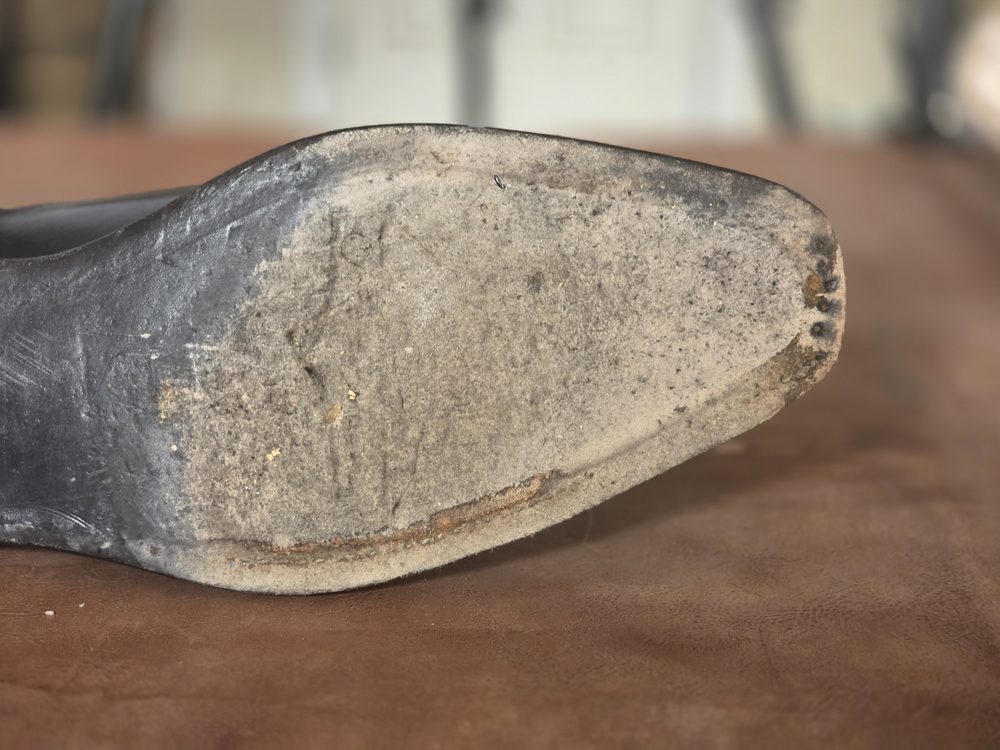
One of the great benefits of owning properly constructed welted footwear is that the soles can be replaced. And in the hands of a highly skilled cobbler, even shoes that appear well beyond saving can sometimes be brought back to life.
A perfect example of this is Steve Doudaklian of Bedo’s Leatherworks.
If you’ve never seen Steve’s work, I strongly recommend looking into it. I’ve watched him restore shoes that most people would have thrown away without a second thought, transforming heavily damaged footwear into something that looks almost brand new again.
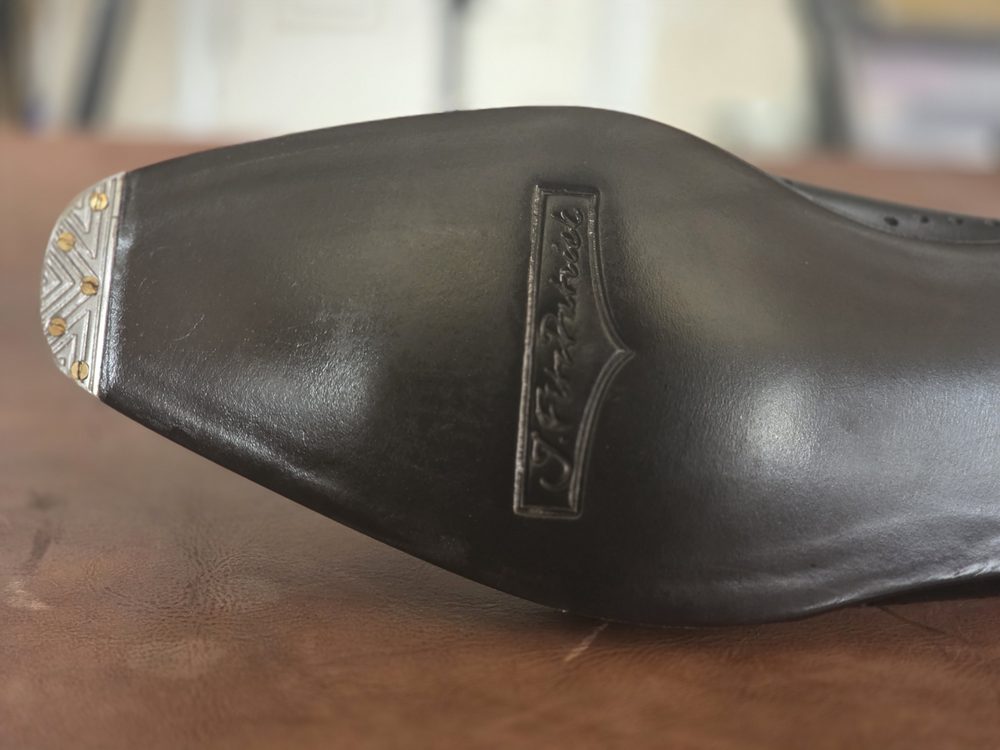
I even featured him on my blog when he completely rebuilt a pair of older J.FitzPatrick shoes, taking them from their original construction to an incredibly elaborate hand-welted resole with a fiddleback waist.
You can see that transformation in my article, Handwelted Resoling With Fiddleback by Bedo’s Leatherworks.
It’s a wonderful example of what can be accomplished when quality footwear meets exceptional craftsmanship.
Naturally, not every repair makes financial sense, and not every cobbler is capable of performing this level of restoration. But it demonstrates that even significant sole wear doesn’t automatically mean the end of a good pair of shoes.
The Irony of Beautiful Leather Soles
And this brings me back to the internal struggle I’ve had over closed-channel soles throughout my career.
There is something almost ironic about spending so much time and effort creating a beautiful leather sole, knowing full well that the very first steps someone takes on concrete will begin destroying that beauty.
All of those carefully finished edges, perfectly concealed stitches, and beautifully decorated leather surfaces are destined to be worn away. That’s what soles are for, after all. They’re meant to be walked on.
Yet I think the beauty of a new closed-channel sole sometimes creates an unrealistic expectation that it should somehow remain that way indefinitely. And when a piece of that beautiful finish breaks away earlier than expected, people understandably become concerned.
But a sole isn’t a decorative object. It is a functional component of a shoe that takes a beating with every step. Whether the channel covering wears away gradually over several years or a small section gets caught on something after a few wears, the underlying principle remains the same.
The disappearance of that leather covering does not, by itself, mean the sole has failed. The real concern is when the leather itself wears down to the point where its structural integrity is compromised.
So the next time you notice a little exposed stitching on the bottom of your shoes, don’t automatically assume something is wrong. Take a closer look. Understand what you’re seeing. And remember that even the finest shoes in the world are subject to the same realities of wear and tear.
Sometimes a little cosmetic damage is simply part of the natural aging process.
I hope this helps clear up what I believe to be a very common misunderstanding in the world of fine footwear.
And if you know someone who has experienced the same concern, please share this article with them. The more we understand how our shoes are constructed and how they naturally wear, the better equipped we’ll be to care for them properly.
As always, thanks for reading!
Shoes by Edward Green, found at Leffot: https://leffot.com/









Now those are well worn shoes. Probably abused too. I have seen on some closed channel soles that the center of the sole is protruding further than the stitched welted area. Not a flat sole as I guess these were. I believe those shoes are repairable. Thanks for posting these interesting articles.
Thanks for sharing Arthur, glad that you enjoyed it