

It might seem trivial, but knowing how to lace your dress shoes properly is something many people fail to accomplish. All aspects of clothing have a purpose and an intention of fit. When failing to adhere to the intention, it creates problems, not only in fit, but also in comfort and support. So, here we will discuss why it matters and how to lace your shoes properly.
Why properly tying your shoes matters
A shoe should hug your foot. It is meant to feel like it belongs. Almost like an extension of self. When you feel like you can slip it on and off without tying it, that means you are doing it wrong. That is what loafers are for. Laces are meant to be tied tightly, not to the point of cutting off circulation, but so that the shoes remain firmly in place, moving with your feet and not to their own drumbeat.
How tight should dress shoes actually be?
The shoelaces should be tied enough so that there is no looseness in the top holes and knot, but not so tight that it hurts. But allow me to say that ‘hurting’ and feeling the slightest discomfort are not the same. Far too many are overly sensitive to the laces properly tied up and then have loose-fitting shoes coming off their feet, causing other issues.
The laces should come as close to touching as possible without being able to overlap. 1-2mm of space between the facings is acceptable. A V-shaped gap is not ideal unless you have a very high intep are are tying as tightly as possible. While also not ideal, people with high insteps often have issues finding properly fitting lasts. So this post is less for you and more for people with ‘normal’ height insteps.
But if you do have a super high instep and want to find properly fitting oxfords, search for lasts that accommodate a high instep. There are makers out there who accommodate this.

Heel slip and loose lacing
Dress shoes not laced properly inevitably cause heel slip. Heel slip inevitably causes your arch to overwork itself. Overworking your arch can cause foot issues, such as plantar fasciitis. And that is not something anyone wants to experience. Trust me.
Shoes not properly tied that cause your heels to slip out with each step simply look uncouth. It is a sloppy look that shows one doesn’t care. Not caring defeats the purpose of wearing dress shoes. A stylish man always has their shoes tied properly.
Another issue is when trying on dress shoes for the first time, if you do not lace them properly, you might feel that they are too big. Time again, I have been selling shoes to guys who barely laced them, had heel slip, and said they were too big. I then laced them up for them, snugged them up, and they realized the fit was then accurate. It always baffled me, the lack of common sense there.
The correct way to lace Oxfords and Derbies
While this is largely subjective, here are my thoughts on how these styles of shoes should be laced.
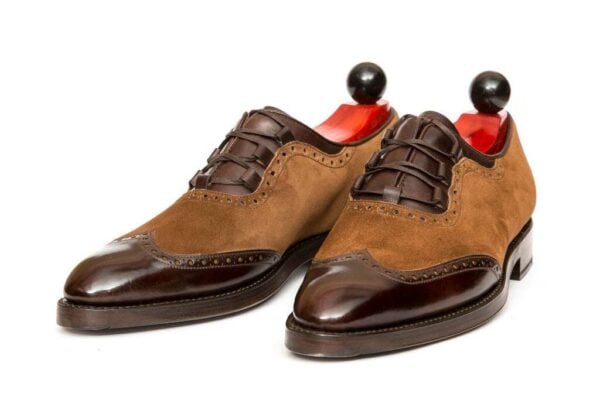
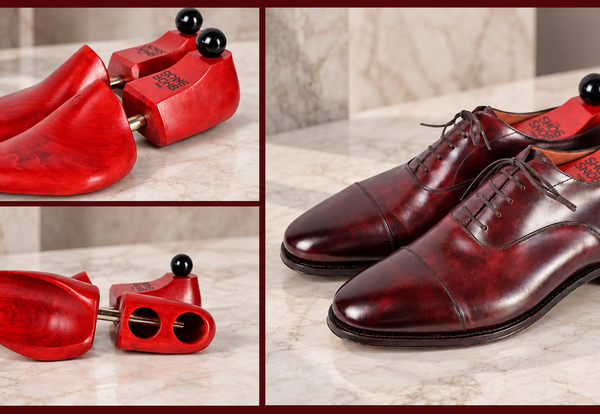
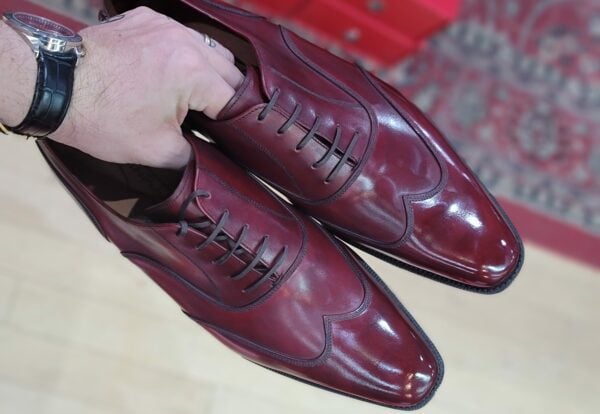
Oxfords should have straight lacing. There are several ways to do that, but the fact remains that this manner of lacing is the most elegant. For those who do not like to see the laces underneath the facing, allow me to say that lacing up the sides of the facing and never crossing under does not create a proper hold. The tension is thrown off and does not stay in place properly. A straight lacing on the top with crossing underneath is the proper way to lace your oxfords. You can see that in the main image.
Derbies, on the other hand, depend very much on the style of derby. Sharper derbies with 2-3 eyelets, and an elegant last with minimal decor should also have straight lacing. More casual derbies, however, can be worn with criss-cross lacing for a more relaxed, casual look.
Oxfords should never be worn with criss-cross lacing. They are not sneakers. They are formal footwear.

Your shoelaces matter more than people think
Of course, tying your shoes properly also assumes that you are using appropriate shoelaces in the first place. Lace thickness, shape, material, and wax content all affect both how a shoe looks and how well the knot stays tied. I personally feel that flat laces are the most appropriate for all dress styles. You can read more about my opinion on that here.
Round laces have their place, just like criss-cross lacing on a derby does. But this does matter. Chunky round laces can look out of place on an oxford. Overly fine flat laces can look too formal on a casual style. The more formal, go flat. The more casual, go round. Thickness is also important. Leather shoes should have fine laces. Not thick, chunky ones.
I offer flat, wax cotton laces on www.theshoesnob.com for all sizes between 60cm and 150cm. I even offer bundle deals for multiple pairs purchased.
When to replace your shoelaces
If your laces fray, you need to replace them. Ratty-tatty laces look terrible on fine dress shoes. Or any shoes, for that matter. One thing that I like about flat, waxed cotton laces is that you can flatten them by ironing them.
If you live in a sunny area, it is likely that your laces will lose their color over time. Once they have lost a good amount of color, it is also best to replace them. That faded look on nice leather is also an eyesore. Keep your laces clean, tidy, and replace them often. Ratty-tatty is never a good look.
You would be surprised, but a new pair of laces can also freshen up an old pair of dress shoes. Clean, crisp dress shoelaces are like a new haircut.
How to lace your dress shoes and maintain your shoelaces might seem trivial, but it is just as important as polishing and keeping up with the rest of your shoe care regimen.
—Justin FitzPatrick, The Shoe Snob
Shop · Marketplace · Patreon






I stand guilty of this error. Thanks for the info, I will not make this error again.
Dear Justin,
nice article. One of the things I have very much difficulty with is the fact when people do not use the shoe horn to put on a pair of good shoes…To me
this shows a lack of respect for the people who have putted a lot of energy and work in the making of the shoes.
I’m retired and haven’t purchased a pair of “good” shoes for a few decades, but even back then the salesmen had stopped putting the shoes on your feet.
Why and when did this happen?
Is there a good reason for it?
I can’t help but put it in the same category of people being allowed to talk out loud in libraries.
Good point, although I’d like to introduce a couple complications:
1. Bluchers/derbies do not have both sides touching when the fit is ideal.
2. Even properly fitting oxfords should have a bit of space up top when new, so that as they stretch with wear, the laces can be tightened further. Otherwise the shoe will be too loose when they stretch. (This last part I learned from Bengalstripe and DWFII on SF.)
Great article Justin. I bar lace all my dress shoes and I use a Parisian knot. I used to use a Berluti knot, but my hands are too shaky now to get it just right. I really like the flat narrow cotton waxed laces from Kirby Allison. He seems to be the only dealer that has them for sale. I will check your store for them. Take care!